


India has identified infrastructure, critical minerals, and skills development as three key areas where South Africa can expect deeper cooperation over the next five years.
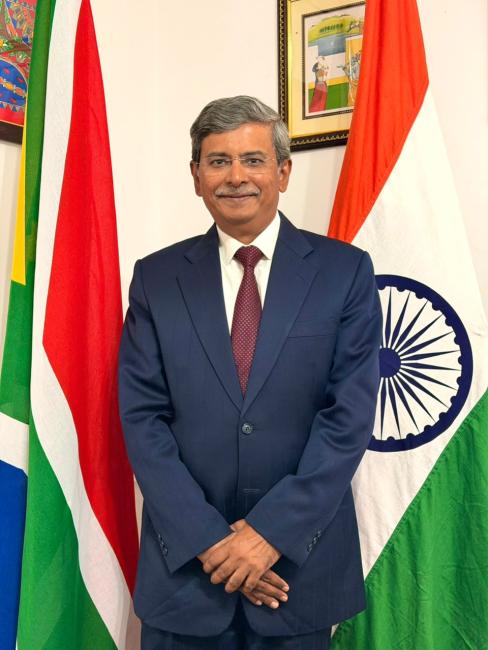
Speaking ahead of the BRICS Summit, India’s High Commissioner to South Africa, Shri Prabhat Kumar, told SAnews.gov.za the two countries have strong prospects for expanding economic cooperation, investment and technical exchange.
Kumar said India had made significant progress in digital public infrastructure, logistics, science and technology.
“Our railways cover the whole country, and we are able to transport people and freight at a very reasonable cost across India. That can be a good area of cooperation with South Africa.
“We have developed our ports very well. Logistics is one area where there can be good cooperation between India and South Africa. The other area, as I mentioned, is critical minerals,” he said.
He added that India is seeking to develop all areas related to critical minerals, particularly those linked to renewable energy and semiconductors.
“In this area, we can help South Africa not only by sourcing the minerals directly, but also through beneficiation. South Africa has a good quantity of critical minerals, and India, as a developing country, will always require these minerals.
“That is another area. The third area that I think offers strong potential for cooperation is skills development, because we have done well in some fields,” Kumar said.
India already supports skills development initiatives in South Africa, including the Gandhi-Mandela Centre of Specialisation for Artisan Skills at Tshwane South Technical and Vocational Education and Training (TVET) College’s Pretoria West Campus. It is also establishing another skills development centre in Majuba.
“We can cooperate in skills development in other areas as well. We have already established cooperation with some universities so they can exchange curricula and other resources, ensuring that students who graduate are well equipped for the job market,” Kumar said.
He said India’s goal is to become a developed country by 2047 - the year the country will mark 100 years of independence.
“We expect and believe that South Africa can be an important partner in India’s journey to becoming a developed country. Both countries can contribute to each other’s economies and progress,” he said.
Kumar said this cooperation is already evident in trade and investment, with Indian companies investing in South Africa and South African companies investing in India.
Last month, South African citrus exporters gained improved market access to India after the approval of additional cold-treatment options for fresh citrus fruit, following nearly a decade of negotiations.
“Around six months ago, we approved avocado exports to India. These exports will now take place. I think avocados may already be reaching India, and citrus will start reaching India soon.
“Apples and pears are also important. I think India is one of the biggest markets for South African apples and pears. We are also importing gold and diamonds from South Africa.
“India is also trying to export some of its products, including plant products. I think we can work together to make this easier. We see South Africa as an entry point to the larger African market,” Kumar said.
Digital public infrastructure improves service delivery
The High Commissioner said India has made significant progress in building digital systems that allow citizens to access services more easily.
He said India’s experience in digital public infrastructure could offer lessons for South Africa as both countries look for ways to improve access to government services and strengthen people-centred cooperation.
“We started developing this around a decade back. And now you can see that we are able to do business with everyone. Everyone has a bank account, everyone has a digital ID, and everyone has a mobile phone,” Kumar said.
He said the combination of these three elements has made digital public infrastructure and digital money transfers easier.
“We have a cash benefit transfer system, through which benefits such as scholarships or support for farmers are transferred instantaneously.
“And if you go to India, you will see that through this, what we call digital payments, all payments can be made digitally. Even a street hawker is taking digital payments, so everyone is linked. And that is public infrastructure,” Kumar said.
India also has a digital repository for college degrees and school certificates that can be accessed by anyone.
“We store them in a wallet on our phones, and they can be shown to anyone. It can be verified. Our passport services have also become digital. So for public services, there are more than 100 services which can be obtained digitally.
“We also have kiosks in villages that help people access services. In this area, we can cooperate with South Africa. We are already working with some parts of government on cooperation, but this can obviously make services easier and more business-like,” the High Commissioner said.
South Africa and India have a longstanding relationship grounded in shared history, cultural ties and a mutual vision of non-alignment, aimed at advancing the Global South through South-South partnerships.
Kumar said India and South Africa share a long historical relationship, including India’s support for the anti-apartheid movement and Mahatma Gandhi’s time in South Africa.
“We have been strategic partners since 1997. And since then, of course, we have cooperated on many issues. We have an excellent political relationship. We want to utilize this relationship to further advance our goals,” he said. -SAnews.gov.za


