


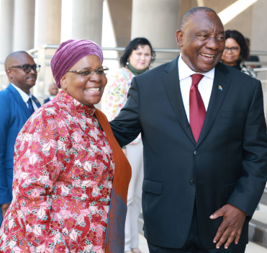
President Cyril Ramaphosa has called on South Africa and Namibia to seize a historic opportunity to transform their abundant natural resources into engines of industrialisation, job creation and regional prosperity.
Opening the Fourth Session of the South Africa–Namibia Bi-National Commission (BNC) in Pretoria on Friday, President Ramaphosa said the two neighbouring countries must shift their focus from simply extracting resources to building regional value chains that produce finished products and create sustainable employment.
“The question before us is not whether Africa possesses these resources. The question is whether Africans will capture the value they create. Our objective should be to build regional value chains that produce finished products, rather than merely exporting raw materials.
“For too long, Africa has exported opportunity while importing prosperity. We have exported raw materials and imported manufactured goods. We have created industries elsewhere while unemployment has remained one of our greatest challenges at home,” President Ramaphosa said.
He emphasised that this model cannot define Africa's future.
“The days when our minerals leave our shores simply as rock and dust must steadily come to an end. Instead, we should increasingly process, refine, manufacture and innovate here in Southern Africa, creating value for our own economies and opportunities for our own people,” he said.
President Ramaphosa co-chaired the Fourth Session of the BNC with Namibian President Netumbo Nandi-Ndaitwah following meetings of senior officials, held from 14 to 15 July, and a Council of Ministers meeting on 16 July, where delegates prepared recommendations for consideration by the two Heads of State.
Established in 2013, the South Africa–Namibia Bi-National Commission is the highest formal mechanism for cooperation between the two countries. The Commission coordinates bilateral relations, reviews progress and identifies new opportunities to strengthen cooperation across political, economic, social, defence and security sectors.
The Fourth Session builds on three previous BNC meetings that have strengthened bilateral relations since the mechanism was established. To date, South Africa and Namibia have concluded 75 agreements and memoranda of understanding covering political, economic, social, defence and security cooperation, as well as historical agreements relating to the handover of Walvis Bay.
Welcoming the Namibian delegation, President Ramaphosa described Namibia as “not merely our neighbour” but “our sister nation” - saying the relationship between the two countries was forged through the shared struggle against colonialism and apartheid.
“The friendship between our countries was forged not by convenience, but through struggle, sacrifice and solidarity. Together, our peoples resisted colonialism and apartheid.
“Together, we stood for justice, freedom and human dignity. Together, we helped shape a Southern Africa that is today defined by democracy, peace and cooperation,” the President said.
He said the Commission represented far more than a bilateral engagement, but rather “our collective determination to build a partnership that advances prosperity for our peoples and contributes to the development and stability of our region and continent.”
While acknowledging the work completed by ministers, senior officials and technical experts over the past three days, President Ramaphosa stressed that implementation would determine the Commission's success.
“The true measure of our success, however, will not be the number of agreements we sign, but the effectiveness with which we implement them. Implementation must now become our foremost priority,” he said.
A major focus of the President's address was strengthening cooperation in strategic sectors expected to drive future economic growth.
He highlighted the Orange Basin, where significant offshore oil and gas discoveries have attracted international attention, as an opportunity to establish an integrated regional energy economy rather than simply exporting resources.
“Its development presents us with an opportunity not simply to extract oil and gas, but to establish an integrated regional energy economy encompassing exploration, engineering, refining, petrochemicals, logistics, maritime services and advanced manufacturing,” he said.
President Ramaphosa congratulated Namibia on its offshore discoveries and said South Africa's own exploration efforts, coupled with the countries' shared geology and geographical proximity, created a compelling case for closer collaboration in exploration, infrastructure development, skills development and investment promotion.
He also pointed to the potential of green hydrogen, saying South Africa's Boegoebaai Deepwater Port and Green Hydrogen Development Programme, located near the Namibian border, presented “an important opportunity for collaboration in building a globally competitive green industrial corridor linking our two countries.”
Mining cooperation, particularly around critical minerals, was another area identified for expansion.
President Ramaphosa said finalising a Memorandum of Understanding on geology and mining would strengthen collaboration on joint exploration, scientific research and downstream beneficiation, while cooperation between the two countries' Councils for Geoscience could unlock new investment opportunities.
The President further emphasised the importance of cooperation on shared water resources, describing water security as a strategic imperative for two water-scarce countries facing growing climate pressures.
“As water-scarce countries sharing important transboundary water systems and aquifers, our cooperation in integrated water resource management is essential not only for sustainable development but also for climate resilience and long-term regional stability,” the President said.
Trade and investment also featured prominently in the discussions.
President Ramaphosa welcomed the growing presence of South African companies investing in Namibia while encouraging greater Namibian investment into South Africa.
He called for stronger partnerships between the private sector, development finance institutions and state-owned enterprises, saying both countries should identify bankable projects in infrastructure, logistics, agriculture, manufacturing, renewable energy and digital technologies.
He added that removing unnecessary trade barriers, improving border efficiency and strengthening transport corridors would be critical to unlocking the full potential of the African Continental Free Trade Area (AfCFTA).
The Fourth Session also incorporates the South Africa–Namibia Business Forum, held under the theme “Driving Regional Industrialisation, Investment and Sustainable Growth Through Strategic South Africa–Namibia Partnerships.”
The forum brings together government and business representatives from both countries to strengthen trade, investment and industrial cooperation.
Bilateral trade and investment relations have continued to grow, with more than 50 South African companies investing in Namibia between 2023 and 2025. These investments contributed approximately US$1.2 billion in capital and created around 4 900 jobs across sectors including mining, banking, insurance, property and renewable energy.
A closer cooperation between the two countries is expected to drive economic growth through expanded trade and investment, industrialisation, infrastructure development and job creation.
The Commission is expected to strengthen trade and investment, deepen industrialisation, expand energy cooperation, improve transport corridors, enhance food and water security, and support greater regional integration through the Southern African Development Community (SADC), the African Union (AU) and the African Continental Free Trade Area (AfCFTA).
The Fourth Session of the BNC is also expected to culminate in the signing of six cooperation agreements covering employment and labour, public administration capacity building, air services, legal cooperation, correctional services, and economic cooperation between the South African and Namibian Chambers of Commerce and Industry.
On regional peace and security, President Ramaphosa reaffirmed both countries' commitment to African-led solutions to African challenges, expressing concern over instability in the eastern Democratic Republic of the Congo, Cabo Delgado in Mozambique, Sudan, South Sudan and parts of the Sahel.
“Without peace there can be no investment. Without security there can be no sustainable development,” he said.
At the international level, he said South Africa and Namibia remained committed to multilateralism, international law and reform of global governance institutions, including the United Nations Security Council.
President Ramaphosa also addressed migration, saying South Africa would continue enforcing its immigration laws “firmly, fairly and consistently” while upholding constitutional values and human dignity.
He said sustained dialogue, stronger border cooperation, orderly labour mobility and inclusive economic development remained the most effective long-term responses to migration pressures across the continent.
Concluding his address, the President urged both countries to build on the legacy of solidarity inherited from previous generations.
“Our responsibility is to leave to future generations a partnership that is even stronger—one that delivers opportunity, prosperity and hope to every citizen of South Africa and Namibia.
“May this Fourth Session of our Bi-National Commission be remembered not simply for the agreements we conclude, but for the momentum we generate and the future we build together,” he said.
He then officially declared the Fourth Session of the South Africa–Namibia Bi-National Commission open. – SAnews.gov.za


