


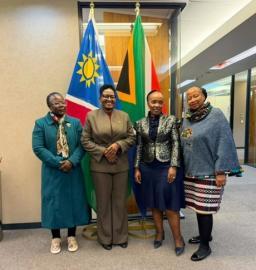
South Africa and Namibia are set to deepen bilateral cooperation on gender equality and women's empowerment, following talks between Minister in the Presidency for Women, Youth and Persons with Disabilities Sindisiwe Chikunga and Namibia's Minister of Gender Equality and Child Welfare, Dr Emma Kantema.
The bilateral meeting took place on the sidelines of the Fourth Session of the South Africa-Namibia Bi-National Commission (BNC), held at the Department of International Relations and Cooperation (DIRCO) in Pretoria on Thursday, 16 July 2026.
Addressing the meeting, Chikunga said the two countries' longstanding historical and political ties continue to provide a strong foundation for cooperation on social and economic development, particularly in advancing the rights and empowerment of women.
She said South Africa and Namibia's relationship is underpinned by shared history, geographic proximity and collaboration through regional and multilateral institutions, including the Southern African Development Community (SADC), the African Union and the United Nations.
A key outcome of the engagement is the anticipated signing of a bilateral agreement on cooperation in gender equality and women's empowerment during the Fourth Bi-National Commission.
The agreement, first initiated in 2022, provides a framework for collaboration in six priority areas, including the preventing and eliminating femicide and all forms of violence against women and girls; sharing expertise on national legislation, programmes and strategies to prevent and combat GBVF; exchanging strategies to enable adequate representation of women in decision making positions in the public and private sectors, including capacity-building.
It also includes joint programmes on the empowerment of women in the agricultural sector and other economic sectors identified by the Parties; joint training of women and girls in conflict resolution under the Women, Peace and Security agenda; and joint participation in national, regional and international dialogues on entrepreneurship and women’s economic empowerment.
Chikunga welcomed progress made by officials from both countries in finalising the agreement and said its implementation should be guided by a clear action plan.
“As we sign tomorrow [Friday], this must translate into a concrete Implementation Plan with clear targets and timeframes,” the Minister said.
The Minister also outlined South Africa's priorities ahead of assuming the chairship of SADC, saying the country would work closely with member states, including Namibia, to accelerate implementation of the SADC Regional Indicative Strategic Development Plan (RISDP) 2020–2030.
She noted that the Department of Women, Youth and Persons with Disabilities, together with the SADC Secretariat, convened a virtual meeting of SADC Ministers responsible for Gender and Women's Affairs on 26 June 2026 as part of preparations for South Africa's leadership of the regional bloc.
South Africa is expected to host the 46th Ordinary SADC Summit of Heads of State and Government in August 2026.
“Our strategic approach will be informed by the imperative to implement the SADC Regional Indicative Strategic Development Plan (RISDP) 2020–2030, so that it is fully realised by its planned date of expiry. Our Chairship coincides with the ongoing Mid-Term Review of the RISDP, whose outcomes will provide reliable data on the scale and extent of implementation so far,” Chikunga said.
The Minister reaffirmed South Africa's commitment to working closely with Namibia and other SADC member states to advance gender equality, women's empowerment and broader regional development priorities. – SAnews.gov.za


