


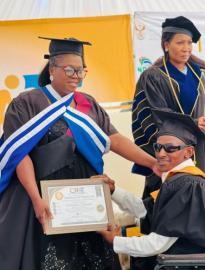
Minister in the Presidency for Women, Youth and Persons with Disabilities Sindisiwe Chikunga has called for urgent action to remove the barriers that continue to prevent learners with disabilities from accessing quality education and meaningful employment opportunities.
Delivering the keynote address at the Recreation Aid Foundation (RAF) Graduation Ceremony in Soshanguve, north of Pretoria, on Wednesday, Chikunga said South Africa must build an education system that embraces inclusion and ensures every learner has an equal opportunity to succeed.
Congratulating the Class of 2026, the Minister commended the foundation for empowering academically disadvantaged learners and young people with special educational needs through academic and vocational training.
She stressed that the greatest obstacles facing learners with disabilities are not their disabilities, but education systems and environments that fail to accommodate their needs.
"The obstacle is not the learner's difference. It is the exclusionary design of our schools, our systems, our curricula and, more often than not, our attitudes," Chikunga said.
The Minister highlighted that many schools, particularly in townships, rural areas and farming communities, continue to operate from buildings that were never designed to accommodate learners with disabilities. She added that inadequate assistive devices and limited specialist support remain major challenges.
"Many of our schools still operate in buildings never designed with accessibility in mind: classrooms without ramps, corridors too narrow for a wheelchair, toilets that cannot be used by a child with mobility needs.
"These physical impediments are not neutral. If a learner cannot enter a classroom with dignity, the conversation about inclusive education has already failed before the lesson begins," she said.
Chikunga emphasised that inclusive education must be built on respect, high expectations and a genuine sense of belonging, rather than "pity or tolerance".
She also called for stronger investment in teacher training to better equip educators to support inclusive classrooms, noting that while South Africa has a progressive policy framework, implementation continues to lag.
"We are not short of policies – it is implementation that continues to falter. Our White Paper on the Rights of Persons with Disabilities is lauded on multilateral platforms," she said.
Among the proposals announced was the transformation of special schools into resource and support hubs serving the broader education system.
Drawing on international best practice, Chikunga said special schools should become centres of expertise that provide outreach services, adaptive curriculum resources and specialist support to mainstream schools.
"By resourcing special schools to act as knowledge exporters, rather than silos, we multiply their impact across entire districts, especially those that are lagging behind. We need investment sufficient to embed multidisciplinary support teams within special schools," she said.
The Minister noted that South Africa's Constitution, the White Paper on the Rights of Persons with Disabilities and the National Development Plan all recognise disability inclusion as a national priority.
According to the National Development Plan (Vision 2030), persons with disabilities account for about 12.34% of South Africa's population. Government is working towards ensuring that at least 10% of employment opportunities and 7% of skills development opportunities are reserved for persons with disabilities by 2030.
Chikunga also outlined several initiatives aimed at expanding opportunities for persons with disabilities, including closer collaboration with the National Skills Fund's R1 billion Disability Support Fund, launched in 2024 to support workplace training, enterprise development and economic inclusion.
She said her department also plans to partner with state-owned enterprises, Sector Education and Training Authorities (SETAs) and industry to channel corporate social investment towards improving infrastructure and educational outcomes at special schools.
Another initiative under development is the Disability Inclusion Research, Advocacy and Mainstreaming Centre of Excellence, which will support teacher training, help bridge the digital divide and promote disability-inclusive education across the country.
Congratulating the graduates, Chikunga said their success reflected not only their determination but also the unwavering support of their families, educators and communities.
"Your achievement today is not only your own. It is the achievement of your families, your teachers and your communities, and of every South African who believes that our society is stronger when every one of its members is included, respected, and equipped to lead," the Minister said. – SAnews.gov.za


