


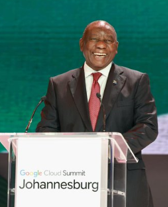
President Cyril Ramaphosa says South Africa is positioning itself as a leading digital investment destination, with growing confidence from some of the world's biggest technology companies expected to drive economic growth, innovation and job creation.
In his weekly newsletter to the nation on Monday, the President said the country's ambition is increasingly being recognised by global technology firms, citing Google's decision to host its first-ever African Cloud Summit in Johannesburg.
"That the company chose South Africa to host one of its most important technology and enterprise events affirms Africa's position as a core growth region for the global cloud ecosystem," he said.
At the summit, Google announced several investments under its "Building for Africa" initiative, aimed at supporting the adoption of cloud technologies and equipping local ecosystems for artificial intelligence (AI)-driven innovation.
Among the projects is the construction of a Digital Exchange Port in the Eastern Cape – the first of four connectivity hubs planned for the continent to improve reliable cloud services.
The company also committed to developing digital skills by establishing a R3 million digital innovation centre at South West Gauteng TVET College in Soweto.
Applications for the 2026 South African cohort of the Google for Startups Accelerator will also open later this month, with 15 local start-ups set to receive AI training, mentorship and funding.
The President said these announcements add to growing investment in the country's digital economy.
He noted that Amazon Web Services announced plans in 2023 to invest R30.4 billion in South Africa's cloud infrastructure, while Microsoft committed R5.4 billion last year towards expanding local hyperscale cloud and AI infrastructure.
He also highlighted Mastercard's launch of its Africa Cybersecurity Centre of Excellence, which will initially roll out in South Africa and Nigeria to strengthen cyber resilience across the continent.
The President said the digital economy is becoming an increasingly important driver of economic growth and employment worldwide.
He noted that Google estimates its Johannesburg Cloud Region could contribute approximately R1.7 trillion in additional gross economic output by 2030 while supporting around 315 000 jobs.
President Ramaphosa said South Africa already hosts a significant share of Africa's large data centre capacity and remains the continent's largest cloud market, with more businesses adopting cloud computing, machine learning and AI technologies.
He said small, medium and micro enterprises (SMMEs) stand to benefit significantly from greater cloud adoption, with one study estimating that cloud computing among SMMEs could unlock more than R185 billion for the economy by 2030.
"Cloud enables small businesses to spend less on IT costs, improve their productivity and become more competitive. It can help them to expand market access and make use of e-commerce," he said.
The President added that government is working through initiatives such as the SA SME Fund, the Black Business Supplier Development Programme (BBSDP)and partnerships with the private sector to make cloud technologies more affordable for small businesses.
The SA SME Fund is a collaboration between government, labour and business. The initiative was set up to to support small to medium-sized enterprises while the BBSDP is a s a cost-sharing grant offered to small black-owned enterprises to assist them to improve their competitiveness and sustainability.
He also said cloud infrastructure can improve government efficiency and public service delivery, including better access to digital learning materials through education platforms.
Safeguarding citizen rights
While promoting digital transformation, Ramaphosa stressed the importance of safeguarding citizens' rights, protecting privacy and ensuring South Africa maintains control over its digital future.
"Our regulatory and policy environment must match innovation with safety. We must learn from other countries where vast amounts of sensitive public and private data have been held by private firms and outside national jurisdictions," the President said.
He said digital sovereignty is becoming increasingly important.
"In the digital age, sovereignty is measured not only by territorial borders. It is increasingly measured by a nation's ability to secure its data, develop its own digital capabilities and exercise meaningful control over the technologies on which its economy depends. That is why government is investing in its own cloud infrastructure through institutions like the Council for Scientific and Industrial Research (CSIR)," he said.
The President said South Africa has a unique opportunity to use modern digital technologies to accelerate development. He cautioned that the country must focus on building its own capabilities rather than becoming dependent on others.
"As we navigate these complexities, we must deepen collaboration across government, business, labour, industry and civil society in pursuit of a digital future that is secure, inclusive and leaves no-one behind," he said. – SAnews.gov.za


