


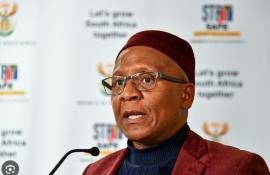
Public Service Commission (PSC) Commissioner Anele Gxoyiya says the non-payment of invoices by government departments within 30 days remains a concern and violates the Public Finance Management Act.
“The non-payment of invoices by government departments is a contributing factor to the lack of sustainability in the small businesses environment,” Gxoyiya said on Wednesday in Pretoria.
The Commissioner was addressing the media in Pretoria, where he attributed the persistent non-payment of invoices in supply chain operations to structural weaknesses, including a lack of consequence management and insufficient monitoring at lower operational levels.
As a result, the cash flow of Small, Medium and Micro Enterprises (SMMEs) is compromised, forcing suppliers to borrow money to meet contractual obligations and, in some cases, retrench staff or close their businesses.
According to National Treasury’s 2025/26 third quarter report on Non-Compliance with Payments of Suppliers’ Invoices within 30 days, the number of invoices older than 30 days and not paid by national and provincial departments at the end of the third quarter of the 2025/26 financial year stood at 90 856, with a rand value of R15.5 billion.
“This represents a regression of 25%, or 4 543 invoices, compared to the end of the second quarter of the 2025/26 financial year, which had 95 399 invoices with a rand value amount of R12.4 billion.
“Provincial departments account for 98% of invoices older than 30 days and not paid, and they also account for 98% of the R15.5 billion,” Gxoyiya said.
Gxoyiya said the number of invoices paid after 30 days by national and provincial departments during the third quarter of the 2025/26 financial year stood at 89 499, with a rand value of R10.8 billion.
“Provinces continue to be the highest contributors to the statistics of late payments and unpaid invoices, and interventions must be prioritised at the provincial level. The provincial departments that contributed the highest number of invoices paid late or not paid during the third quarter of the 2025/26 financial year,” he said.
National departments that contributed the most to the late or non-payment of invoices for the third quarter of the 2025/26 financial year were Home Affairs; Land Reform and Rural Development; Water and Sanitation (Trading Account); Public Works and Infrastructure (Trading Account); Forestry, Fisheries and the Environment; and the Department of Justice and Constitutional Development.
The Department of Defence reported the highest number of invoices paid after 30 days during the second quarter, at 15 769, or 80% of invoices, amounting to R450 million.
The Department of Public Works and Infrastructure reported the second highest number of invoices paid after 30 days during the same period, at 1 391 invoices, or 7% of the total number of invoices paid after 30 days by national departments, with a rand value of R216 million.
Gxoyiya said the non-payment of invoices is counterproductive to government’s vision of economic development, job creation and poverty alleviation.
“In the absence of clear accountability frameworks or enforcement mechanisms, delayed or ignored payments often remain unresolved, fostering a culture of complacency,” the Commissioner warned.
He added that weak oversight among junior supply chain staff further contributes to poor tracking of invoice status, ineffective follow-up and limited escalation of outstanding payments.
“These challenges are compounded by inefficient internal controls, fragmented interdepartmental communication, delays in invoice verification and approval, and limited real-time visibility into financial obligations.
“Capacity constraints, skills gaps, and reliance on manual processes also heighten the risk of errors and extend payment cycles. Collectively, these shortcomings erode supplier confidence, strain business relationships, and undermine the efficiency and long-term sustainability of the supply chain,” the Commissioner said. – SAnews.gov.za


