


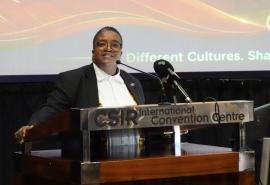
Deputy Minister in the Presidency for Women, Youth and Persons with Disabilities, Mmapaseka Steve Letsike, has called for women to play a central role in South Africa's National Dialogue process.
Addressing the Women's Sector National Dialogue Preparatory Summit on Wednesday, Letsike said the dialogue offered an opportunity to move beyond legal guarantees of equality and focus on whether institutions, the economy and society were delivering meaningful change in women's daily lives.
"This year marks the 70th anniversary of the historic Women's March of 1956 and 30 years since South Africans adopted the Constitution," she said.
"Our generation has the responsibility to carry that work forward by ensuring that equality is not simply protected in law, but experienced in the daily lives of women and girls."
Letsike said South Africa had no shortage of women's voices in public life, but institutions had often failed to respond adequately to the challenges women consistently highlighted.
She pointed to continued high levels of unemployment and poverty among women, the vulnerability of female-headed households, the burden of unpaid care work and ongoing gender-based violence as evidence that gender equality remains unfinished business.
"These are not separate challenges. They are deeply connected," she said.
The Deputy Minister argued that the National Dialogue should examine whether existing systems need to be redesigned to make gender mainstreaming a permanent feature of government and economic planning.
She raised questions about how public transport, childcare systems, digital transformation and local economic development could be structured around the realities faced by women, including entrepreneurs, informal traders, farm workers and women with disabilities. "These are not simply women's questions. They are nation-building questions," she said.
Letsike also urged participants to consider emerging challenges, including artificial intelligence, climate change, declining trust in democratic institutions and growing attacks on the rights of women and other marginalised groups.
She cited international examples, including Uruguay's care economy reforms, Spain's integrated approach to gender-based violence and Iceland's accountability measures on equality, while stressing that South Africa would need solutions tailored to its own history and constitutional framework.
The Women's Sector National Dialogue Preparatory Summit forms part of broader consultations feeding into South Africa's National Dialogue process, which aims to reflect on the country's democratic progress and future direction.
Letsike said women should participate in the process not merely as stakeholders seeking recognition but as partners in shaping the country's future.
"The success of the National Dialogue will not ultimately be measured by the conversations we have, but by the institutions we strengthen, the opportunities we create, and the extent to which every woman, every young person and every person with a disability can experience the full promise of our constitutional democracy," she said. – SAnews.gov.za


