


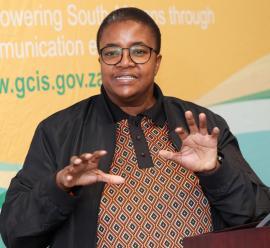
Deputy Minister in the Presidency for Women, Youth and Persons with Disabilities, Mmapaseka Steve Letsike, has called for structural women’s empowerment that rejects discrimination and advances equality, economic ownership and women’s leadership, while reflecting on the gains made since the advent of democracy.
Letsike was addressing women at the Fray Media and Government Communication and Information System (GCIS) Rise and Shine Women in Media Breakfast, held under the theme: “Empowered women empower the nation.”
She stressed that empowerment is not the private escape of a few exceptional women from a structure that continues to oppress millions.
“It is the collective redesign of that structure, so the next woman does not have to survive the same violence, exclusion and exhaustion,” the Deputy Minister said on Wednesday in Johannesburg.
She highlighted that democracy fundamentally altered the legal and political status of women.
“These are not cosmetic gains. They have changed who makes law, interprets policy and leads institutions. Our Constitution made equality and non-sexism founding values.
“Democratic South Africa expanded reproductive freedom, strengthened protection against domestic and sexual violence, recognised women in customary marriages and advanced equality in employment,” the Deputy Minister said.
According to Letsike, women’s representation in Parliament had risen from 33% in 2004 to 42.8% in 2024.
In the National Council of Provinces, women’s representation reached 44.4%, while representation in senior public service management rose to 45.2% in 2023.
In addition, more tertiary-qualified women have also entered physical, mathematical and engineering fields.
The Deputy Minister said South Africa needed a care compact built on five commitments: recognising care, reducing its labour, redistributing it across women, men, the state and the market, rewarding paid care workers with decent conditions, and representing care workers in decisions that affect them.
“That means accessible early childhood development, support for older persons and persons with disabilities, reliable water and transport, social protection, parental leave that changes men’s behaviour, and gender-responsive budgets that reveal who benefits and who carries the cost,” she said.
Letsike urged women to confront forms of workplace harassment disguised as humour, familiarity or supposedly harmless comments.
She said remarks about a woman’s health, body, clothing, voice, sexuality, marital status, motherhood or ambition are often dismissed as “just a joke”, with women expected to laugh along or risk being labelled difficult, humourless or overly sensitive.
“We must be clear: there is no derogatory joke that is harmless. Humour does not neutralise humiliation. It teaches the room that a woman’s dignity is negotiable; that her authority can be reduced to her appearance, and that her belonging depends on her willingness to tolerate contempt.
“A workplace committed to equality must interrupt this conduct immediately, rather than asking women to carry it quietly,” the Deputy Minister said.
She said South Africa must build an information economy in which women own institutions, shape technology and receive a fair share of public and commercial value.
“Let it be said that we moved from visibility to ownership, from representation to redistribution, and from policy promise to lived freedom,” the Deputy Minister said. SAnews.gov.za


