


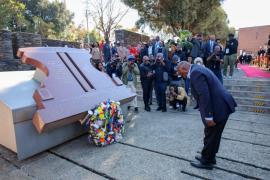
Marking 50 years since the Soweto uprising of 16 June 1976, this year’s Youth Day commemorations coincide with other major milestones of freedom, underscoring that South Africa’s democracy was built across generations.
“In addition to the 50th anniversary of the Soweto uprising, we also mark 70 years since the Women's March of 1956 and 30 years since the adoption of our democratic Constitution in 1996. Together these milestones remind us that freedom was built across generations,” President Cyril Ramaphosa said on Tuesday in Johannesburg.
The youth of 1976 fought against exclusion; today, South Africa is confronting unemployment, poverty and inequality — challenges the President likened to the broader struggle against the oppressive apartheid regime, in which all generations played a role in the fight for freedom.
“Theirs was the struggle to enter the classroom. Ours is the struggle to ensure that what begins in the classroom does not end in the unemployment queue.
“Just as they refused the limits imposed upon them, we too must refuse a future of diminished possibilities. Let us build a South Africa where every young person can realise their potential.
“Let us build a South Africa in which freedom lives in every generation. So let us honour them not in words alone, but in deeds,” the President said.
President Ramaphosa reminded South Africans that these milestones of freedom were achieved by women who resisted pass laws, by young people who rose up against Bantu Education, and by a Constitution that reflects the views and aspirations of all South Africans.
“The young people of 1976 remind us that freedom is not protected by memory alone. It is protected by active citizenship, by organisation, by discipline, by service and by responsibility. As we look to the future, young people must be at the centre of democratic participation,” the President said.
Challenging young people on their role in today’s democracy, President Ramaphosa asked whether they dared to change South Africa.
“The youth of 1976 answered that question. On the 16th of June the children of Soweto walked out of their classrooms and into history. They were told they could not learn in their own language, in their own country, on equal terms. They refused that limit. And many of them paid for that refusal with their lives,” the President said.
He emphasised that the young people of 1976 did not stand alone.
They were supported by parents, teachers, health workers, religious leaders and community structures.
“The youth of 1976 were not the last generation to organise for change. We remember young freedom fighters such as Solomon Mahlangu, the Cradock Four and Nokuthula Simelane, and the youth and student formations that helped make apartheid ungovernable.
“In the democratic era, that same spirit continued through the Rhodes Must Fall and Fees Must Fall movements. Because of these generations of struggle, South Africa has changed fundamentally,” the President said.
The Constitution of 1996 guarantees the right to basic education.
“Through legislation such as the South African Schools Act and the Higher Education Act, we dismantled the legal architecture of apartheid education and began building a system founded on equality, access and redress,” President Ramaphosa said.
He said today’s generation has tools that the youth of 1976 did not have.
“They have technology, information and platforms that can connect communities, expose injustice and build enterprises. Technology must be matched by purpose, organisation and commitment to the common good.
“As the country prepares for the next local government elections, we must place young people at the centre of building municipalities that work,” the President said.
He encouraged young people to register to vote, cast their ballots, engage with municipalities and hold public representatives accountable.
“Democracy is not only what happens in Parliament and council chambers. It is also built in schools, on campuses, in workplaces, in churches, on sports fields, in community halls, on streets, and in homes.
“Let us honour the youth of 1976 not only by remembering their courage, but by continuing the work for which they sacrificed so much. Let us build a South Africa in which freedom lives in every generation,” President Ramaphosa said.
He said the youthfulness of South Africa’s population gives the country a dynamism, innovativeness and potential productivity that few other countries outside the continent can match.
“This generation must take its place in every part of our national life: in the economy, in public institutions, in communities, in innovation, in culture and in the work of building our democracy,” the President said. -SAnews.gov.za


