


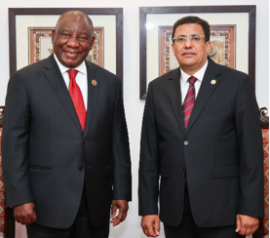
President Cyril Ramaphosa has called on the Pan-African Parliament (PAP) to strengthen its role as the guardian of democracy, champion of African integration and catalyst for translating continental commitments into tangible improvements in the lives of Africans.
Addressing the opening of the First Ordinary Session of the Seventh Legislature of the Pan-African Parliament at Gallagher Estate in Midrand on Monday, President Ramaphosa said the institution carries the hopes of more than 1.5 billion Africans at a time when the continent is grappling with conflict, economic uncertainty, climate change and geopolitical tensions.
“The Pan-African Parliament carries the hopes and aspirations of more than 1.5 billion Africans for peace, progress and prosperity across our beloved continent.
“It is an enduring symbol of unity in diversity, a unity anchored in the conviction that Africa's future must be shaped not only by its governments, but by its peoples,” he said.
President Ramaphosa said recent wildfires in Algeria, Morocco and Tunisia, together with other global challenges, underscored the importance of African solidarity.
“These developments make it even more important that Africa is able to stand together to advance its own development,” he said.
He congratulated Dr Fateh Boutbig and the newly elected leadership of the Pan-African Parliament, expressing confidence that they would advance the mandate of African unity with integrity and purpose.
Reflecting on South Africa's democratic journey, President Ramaphosa said the country remained committed to repaying the solidarity shown by African nations during the struggle against apartheid through contributions to peace, development and institution building.
He highlighted South Africa's role in hosting the inaugural African Union Summit in 2002, helping establish the African Peer Review Mechanism and the New Partnership for Africa's Development (NEPAD), as well as supporting democracy, mediation and reconstruction efforts across the continent through the African Renaissance and International Cooperation Fund.
President Ramaphosa also reflected on Africa's coordinated response to the COVID-19 pandemic, describing it as a powerful example of continental cooperation.
“At a time when vaccine nationalism was taking hold and poorer countries were being pushed to the back of the queue, Africa did not only call for international solidarity. Africa practised solidarity,” he said.
He said the continent had extended its vaccine procurement mechanisms to Caribbean countries, demonstrating that African integration could deliver practical benefits beyond the continent.
President Ramaphosa also commended the Africa Centres for Disease Control and Prevention (Africa CDC) for leading the response to Ebola outbreaks in the Democratic Republic of the Congo and Uganda.
Turning to the role of the Pan-African Parliament, President Ramaphosa said it remained a pillar of Africa's democratic architecture and had a responsibility to ensure African Union aspirations translated into better lives for citizens.
“This Parliament must itself exemplify the democratic values it seeks to advance across the continent.
“It must be a model of integrity, transparency, accountability, responsible stewardship and fidelity to its own rules,” he said.
He welcomed the Parliament's oversight of African Union flagship projects, saying it played an important role in monitoring the implementation of policies critical to Africa's development and integration.
Water security
President Ramaphosa urged parliamentarians to prioritise the African Union's 2026 Theme of the Year: "Assuring Sustainable Water Availability and Safe Sanitation Systems to Achieve the Goals of Agenda 2063."
He described access to clean water and sanitation as a fundamental human right and warned that climate change, ageing infrastructure, pollution and poor governance were placing increasing pressure on water resources.
“The Pan-African Parliament and national parliaments have a decisive role to play.
“They must develop and harmonise enabling legislation, oversee public expenditure, promote investment in water infrastructure and hold governments accountable for delivering reliable water and sanitation services,” he said.
He said South Africa was addressing its own water challenges through the National Water Action Plan while recognising that African countries needed to share knowledge, technology, finance and expertise.
Defending democracy
President Ramaphosa said the Parliament should remain steadfast in protecting constitutional democracy across Africa.
“This Parliament must be resolute in defending constitutional democracy.
“It must speak clearly against unconstitutional changes of government, the unlawful extension of political tenure, the weakening of democratic institutions and the misuse of public resources,” the President said.
He added that democratic governance was essential for peace, development and public confidence in institutions.
AfCFTA key to Africa's future
President Ramaphosa described the African Continental Free Trade Area (AfCFTA) as the continent's most powerful tool for achieving unity and economic transformation.
“The African Continental Free Trade Area is undoubtedly the most powerful instrument we have to realise our cherished goal of African unity, prosperity and progress,” he said.
He said the agreement would only realise its full potential if African countries removed non-tariff barriers, modernised customs systems, improved transport and logistics, harmonised regulations and simplified payment systems.
“The Pan-African Parliament must work with national and regional parliaments to domesticate AfCFTA commitments, harmonise legislation and hold governments accountable for implementation,” the President said.
Managing migration
President Ramaphosa also used the address to call for a balanced continental approach to migration, acknowledging growing concerns in South Africa and elsewhere while warning against xenophobia and misinformation.
“As the South African government, we have taken a firm stance against any form of intimidation, vigilantism or violence directed at foreign nationals,” he said.
He stressed that lawful migrants, refugees and asylum seekers should not be conflated with undocumented migrants or be blamed for unemployment, crime or service delivery failures.
“Our response must combine firm, fair and effective immigration management with an unwavering defence of human dignity and the rule of law,” he said.
President Ramaphosa said African countries needed to address the root causes of migration, including conflict, instability, poverty and weak governance.
“We must work for a future where Africans migrate out of choice and not necessity,” he said.
Building the Africa of the future
President Ramaphosa said Africa's future depended on adding value to its own resources, empowering young people and women, investing in infrastructure and strengthening continental institutions.
He urged African countries to process their own minerals and agricultural products, create jobs for young people and ensure women played a greater role in leadership and economic development.
He also called for Africa to speak with one voice on reform of the United Nations Security Council, the global financial architecture and international trade, climate and technology governance.
“The success of this Seventh Legislature will not be measured only by the debates it holds or the resolutions it adopts.
“It will be measured by the laws it helps to shape, the commitments it helps to implement and the difference it makes in the daily lives of the people of Africa,” he said.
Concluding his address, President Ramaphosa urged the Parliament to remain a force for democracy, peace and accountability.
“History will judge us not by the speeches we deliver, but by the Africa we build. Let this Parliament be the conscience of our continent. Let it be the voice of Africa's most vulnerable.
“Let it be the guardian of democracy. Let it be the champion of peace,” he said. – SAnews.gov.za


