


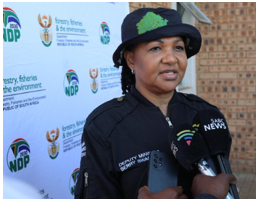
Forestry, Fisheries and the Environment Deputy Minister Bernice Swarts has reaffirmed government's commitment to tackling air pollution, describing clean air as a fundamental human right and calling for stronger collaboration to improve conditions in South Africa's most polluted regions.
Speaking at a Government-NGO dialogue on air quality in the Highveld Priority Area in Johannesburg on Wednesday, Swarts said air pollution extends far beyond environmental concerns.
"It is a social justice issue. It is a developmental issue. Ultimately, it is a human rights issue," she said.
Swarts stressed that access to clean air is protected under Section 24 of the Constitution, which guarantees everyone the right to an environment that is not harmful to their health or wellbeing.
"Air quality is not merely an environmental issue; it is a health issue," she said.
The Deputy Minister said the constitutional right places a shared responsibility on government, industry, civil society and citizens to work together to reduce pollution and improve environmental outcomes.
Her remarks come as communities in the Highveld Priority Area continue to grapple with poor air quality, despite years of interventions aimed at reducing pollution.
The region remains one of South Africa's most significant air pollution hotspots, with emissions from industrial activities, domestic fuel burning, waste burning and transport continuing to affect residents.
Swarts acknowledged growing concerns from communities and civil society organisations about the impact of pollution and the pace of government's response.
"We recognise the concerns raised by residents regarding emissions from industrial activities, domestic fuel burning, waste burning, transportation and other pollution sources," she said.
She also acknowledged calls for greater accountability and transparency in efforts to improve air quality.
"As government, we acknowledge that while progress has been made, much more remains to be done."
Swarts said the dialogue was intended to move discussions beyond differing viewpoints and towards practical solutions that deliver measurable improvements for communities.
"We have gathered to strengthen collaboration, build trust and identify practical actions that can improve air quality outcomes for communities living in the Highveld Priority Area," she said.
She highlighted the G20 Cape Town Ministerial Declaration on Air Quality as an important global framework supporting South Africa's efforts to tackle pollution.
According to Swarts, the declaration elevates clean air to a critical public health, environmental and socio-economic priority, while recognising the disproportionate impact of air pollution on vulnerable communities.
The declaration also promotes stronger air quality monitoring, reliable data, citizen participation, knowledge sharing and cooperation across sectors and spheres of government.
Swarts emphasised that government cannot solve the country's air pollution challenges alone and called on civil society organisations and communities to remain active partners in finding solutions.
"Communities themselves are often the first to experience the impacts of pollution and therefore must be active participants in decision-making processes," she said.
She added that addressing air pollution is also about addressing inequality and ensuring that all South Africans can enjoy their constitutional right to a healthy environment.
"Government is committed to strengthening engagement platforms that allow communities and civil society organisations to contribute constructively to environmental decision-making," Swarts said. - SAnews.gov.za


