


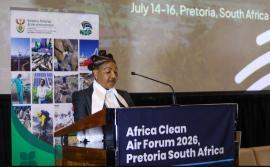
Deputy Minister of Forestry, Fisheries and the Environment Bernice Swarts has called on African leaders to develop a system to transform air quality information management and help improve the lives of millions of Africans who continue to breathe air that does not meet internationally recognised health standards.
“For Africa, clean air is not simply an environmental issue. It is a development imperative. It is about protecting human health, improving educational outcomes, strengthening economic productivity and ensuring environmental justice for present and future generations,” Swarts said on Tuesday in Pretoria.
Across Africa, rapid urbanisation, industrialisation, expanding transport systems, increasing energy demand, agricultural burning, mining activities and waste burning are placing unprecedented pressure on air quality.
“Africa's air pollution challenges do not respect national borders. Transboundary pollution, dust transport, wildfires and regional economic activities require coordinated continental responses,” Swarts said.
The Deputy Minister challenged leaders to consider an African Air Quality Information System to promote capacity building, foster collaboration between national environmental authorities, and provide citizens with accessible air quality information.
“Air pollution is no longer simply an environmental issue. It is a public health emergency, a development challenge, a climate issue and a matter of environmental justice. Poor air quality threatens investment, tourism, food security and sustainable development for developing economies.
“The consequences are visible in rising respiratory illnesses, cardiovascular diseases, lost productivity, increased healthcare costs and the disproportionate impact on women, children, the elderly and vulnerable communities,” the Deputy Minister said.
Swarts was addressing Africa’s leading voices in air quality management, environmental governance, public health, science and policy at the Africa Clean Air Forum.
“As countries strengthen their air quality monitoring networks, there is an increasing need for integrated digital platforms that can collect, analyse, visualise, and disseminate air quality data in a timely and accessible manner,” Swarts said.
The Deputy Minister pointed out that innovation in air quality information management is becoming a critical enabler of improved environmental governance, public health protection and evidence-based decision-making across Africa.
“As governments, we must work together to harmonise policy approaches where appropriate, strengthen monitoring networks, improve emissions inventories, mobilise resources and share technical expertise.
“Regional cooperation can significantly improve our collective ability to understand pollution sources, forecast air quality and implement effective interventions.”
Swarts stressed that the success of Africa's clean air agenda will ultimately depend on the continent’s willingness to move beyond commitments and towards implementation.
The Deputy Minister said implementation will require strong political leadership; sustainable financing; effective institutions; scientific collaboration; regional cooperation; community participation; and shared accountability.
“At a regional level, the Southern African Development Community has an opportunity to build stronger regional systems for air quality governance through harmonised policies, joint monitoring initiatives, shared technical expertise, capacity building and coordinated responses to transboundary air pollution,” Swarts said.
She emphasised that resource mobilisation is a critical enabler of collaborative air quality programmes across Africa, where many countries face common transboundary air pollution challenges but have varying levels of technical, institutional and financial capacity.
“Together, we can create cities where children breathe clean air, communities where economic development does not come at the expense of public health, industries that embrace cleaner technologies, governments that work collaboratively across borders, and an Africa where environmental sustainability becomes a catalyst for inclusive growth and shared prosperity,” Swarts said. - SAnews.gov.za


