


Nearly 39 000 foreign registered vehicles have already been registered on the South Africa Revenue Service's (SARS) new digital Traveller Declaration System.
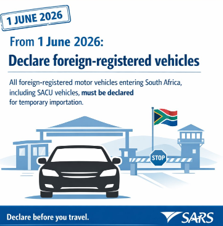
As of 1 June 2026 all foreign-registered vehicles must be declared on the SARS system prior to them entering or leaving South Africa.
“From today, 1 June 2026, all travellers crossing South Africa’s borders must submit an online customs declaration and declare any foreign-registered vehicles they bring into the country.
“This launch of the South African Revenue Service’s (SARS) new digital Traveller Declaration System, together with stepped-up education of customs rules at every port of entry, marks a major step in modernising border controls, streamlining legitimate trade and travel, and curbing non-compliance,” the revenue service said on Monday.
The new requirements are grounded in Section 15 of the Customs and Excise Act, 1964, which obliges travellers to declare all goods, including vehicles, when entering or leaving the country.
READ | Register your foreign registered vehicles before international travel
SARS Commissioner, Dr Johnstone Makhubu, and his senior team were on Monday on the ground at key border posts including Skilpadshek and Kopfontein Border in the North West, and Maseru Bridge and Ficksburg Bridge ports of entry in Bloemfontein to monitor implementation, support front-line officers and provide clarity to travellers as the system goes live.
“SARS is pleased that prior to today’s [Monday’s] launch; foreign registered vehicle owners.. heeded the call of registration with more than 38 900 Temporary Import Permit (TIP) issued by 31 May 2026,” said the revenue service.
Dr Makhubu used the launch to emphasise the legal basis and fairness of these requirements.
“The obligation to declare goods and vehicles at our borders is firmly rooted in South African law, which clearly states that everyone must declare everything they bring into or take out of the country. As SARS, in collaboration with other state law enforcement agencies [we] have a duty to enforce that law consistently and fairly while making it easy for honest travellers to comply,” said the Commissioner.
He noted that even vehicles from neighbouring Southern African Customs Union (SACU) countries must be declared adding that SACU arrangements facilitate trade, but they do not remove customs control.
“A vehicle registered outside South Africa remains a foreign vehicle under our law and must be declared as such. This approach ensures equal treatment and predictability at all our borders and conforms to our strategic intent of fostering voluntary compliance," he explained.
How it works
As of 1 June 2026, all foreign-registered vehicles entering South Africa must be declared to Customs and be issued a TIP at the border, as provided by law. This includes vehicles registered in any other SACU member state.
A TIP allows a foreign vehicle to be used legally in South Africa temporarily. It is valid for up to six months at a time and can be used for multiple entries and exits within that period without needing a new permit for each trip.
In practice, foreign motorists who cross the border regularly for work, business, study or other legitimate purposes do not have to re-register the same vehicle every day, if they hold a valid TIP.
This includes South Africans who trade regularly with a foreign country who possesses a foreign registered vehicle only on the basis that the vehicle is used for business only.
The revenue service also added that there is no fee for obtaining a TIP or for submitting an online traveller declaration, keeping compliance straightforward and free of charge.
“There is no charge for submitting a traveller declaration or for issuing a temporary import permit. Complying with the law shouldn’t impose a financial burden; we have designed these systems to be accessible to all travellers,” said the Commissioner.
To help travellers meet these requirements, all travellers must submit a simple digital declaration of their goods (and any accompanying vehicles) before travel.
This can be done via the SARS website or the SARS MobiApp on a smartphone. After pre-declaring, travellers receive a personal reference number to present at the border.
This digital process is a key part of SARS' modernisation efforts, aimed at making border crossings smoother and more predictable. Modernisation is not about adding red tape but replacing manual, fragmented processes with digital systems that are simpler, faster and more transparent.
The Online Traveller Declaration and the SARS MobiApp allow travellers to arrive prepared, spend less time at the border and experience greater certainty.
“When travellers pre-declare and follow the rules, border processing is quicker and more predictable, and a single temporary import permit covers multiple entries. That’s a real benefit for the many commuters, traders and tourists who cross our borders regularly,” Dr Makhubu said.
Travellers who do not have access to the online system in advance are being assisted by SARS officers at ports of entry, through on-site digital kiosks and staff ready to help capture their information.
In addition, traditional border controls remain in place to verify declarations, and travellers and vehicles must still present themselves to a Customs officer and may undergo inspection if required.
The system can be accessed on : https://www.sars.gov.za/travellerdeclaration/
-SAnews.gov.za


