


Southern African Development Community (SADC) leaders have called for greater regional self-reliance, collective investment and deeper economic integration as the region confronts mounting geopolitical and economic pressures.
This emerged during a media briefing at the conclusion of the SADC Ministers of Foreign Affairs Retreat held at Skukuza in the Kruger National Park, where ministers and regional officials reflected on the impact of global instability on Southern Africa.
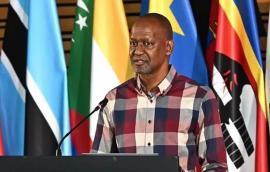
Speaking during a media briefing, SADC Executive Secretary Elias Magosi said one of the key outcomes of the retreat was the recognition that the region must increasingly mobilise and invest its own resources rather than depend heavily on external financing.
“There are resources that are plenty within our space, your pension funds, your insurance funds, your private equities, including even funds that are sitting in the diaspora that can actually be brought back into our region.
“Therefore, it's not every time that when we do projects, when we do activities that require funding, that we should always be looking outside,” Magosi said.
Magosi said ministers acknowledged that many pension funds from the region continue to be invested externally instead of supporting development within Southern Africa.
“What we need to do is determine what type of projects and programs can actually absorb those resources domestically, so they can help us to develop even the financial services sector of our region,” he said.
Energy security also emerged as a central issue during the retreat, with ministers emphasising the need for SADC countries to collectively utilise regional oil and gas resources.
Magosi said Angola and Mozambique’s energy capabilities should be viewed as strategic regional assets rather than national resources in isolation.
“There is a bigger market of close to almost 400 million in SADC, and therefore when you look at oil in Angola, oil in Mozambique, and gas in Mozambique, perhaps that should be the conversation and the picture that emerges,” he said.
He added that ministers agreed the region should explore joint investment and regional partnerships in the energy sector to ensure broader benefits across member states.
“How best can we exploit this together? The retreat actually felt like it enhanced the integration that we talk about,” Magosi said.
The Executive Secretary further highlighted the importance of strengthening regional cooperation in agriculture and veterinary systems, particularly in response to outbreaks such as Foot and Mouth Disease, which have negatively affected exports and small-scale farmers.
“We realised that there is a need for collective action. So, what do we need to do for Botswana to assist Botswana as a region so it's able to produce enough vaccines for the region to address that?” he said.
Meanwhile, South Africa’s International Relations and Cooperation Minister Ronald Lamola said SADC ministers had also prioritised discussions around debt management and regional financing mechanisms.
Lamola said member states were working with institutions such as the African Development Bank and AUDA-NEPAD to establish a “Borrowers Club” aimed at strengthening cooperation among developing countries engaging international financial institutions.
“One of the issues that came through there was the Borrowers Club that we are encouraging. We have mandated our ministers of finance to work together towards this declaration to achieve the formation of the Borrowers Club,” Lamola said.
He said the initiative would allow African countries to collectively engage creditors and address challenges relating to debt and interest burdens.
On energy cooperation, Lamola revealed that ministers were also exploring possible regional investment into Angola’s Lobito refinery project as part of broader efforts to strengthen regional energy resilience.
“We have also encouraged our ministers of energy and finance to look into the possibility of SADC countries joining hands to invest in the Lobito refinery,” he said.
The Minister further addressed concerns relating to migration and recent anti-immigration protests in South Africa, reiterating that migration management must occur within the framework of the law and regional agreements.
“The free movement protocol also does not call for lawlessness; it calls for managed regular migration,” Lamola said.
He stressed that while SADC supports the free movement of people and goods, migration systems must remain regulated and supported by effective border management and law enforcement.
“There must still be processes of paperwork for proper papers that are required,” he said.
Lamola also linked migration pressures to broader regional economic challenges, arguing that stronger economic growth and industrialisation across Southern Africa would help reduce irregular migration.
“We are dealing mostly with economic migrants, so we need the economy of Zimbabwe to grow, we need the economy of South Africa to grow, we need the economy of Mozambique to grow,” he said.
He added that ministers had discussed expanding cross-border special economic zones and increasing regional integration to stimulate job creation and economic opportunity.
“This retreat was very key, was very important, it's an economic solution to the SADC challenges,” Lamola said. – SAnews.gov.za


