


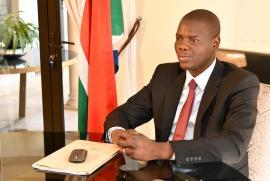
International Relations and Cooperation Minister Ronald Lamola has called for urgent action to tackle hunger and youth unemployment in the Southern African Development Community (SADC), warning that persistent economic hardship could undermine the region’s peace and stability.
Addressing the closing session of the SADC Council of Ministers in Durban on Friday, Lamola said the region needs to accelerate implementation of its development agenda and transform the productive structure of its economies to create more opportunities for its growing young population.
His remarks come as SADC continues to advance its Vision 2050, with regional leaders placing industrialisation, infrastructure development, agriculture and critical minerals at the centre of efforts to achieve sustainable and inclusive economic growth.
“We commend the progress made by Tanzania, Zambia, Zimbabwe and Namibia in pushing back the frontiers of hunger. Even so, 58 million people in our region still live with the uncertainty of where their next meal will come from. This figure is too high and raises the alarm that we must accelerate our efforts,” Lamola said.
He said the challenge was compounded by high unemployment, particularly among young people and women.
“As we noted in our assessment of the state of the region, unemployment exceeds 30 percent in six Member States, placing the relative peace and stability of our region in peril,” he said.
With 60% of the region’s population made up of young people, Lamola said SADC needs to respond to their demand for employment, skills and opportunities, while supporting young people to establish and grow enterprises.
“With 60% of our population being young people, we must respond to their demand for jobs, skills and opportunities, as well as the support they need to build enterprises and thrive,” Lamola said.
Industrialisation key to transformation
Lamola said addressing these challenges require fundamental changes to the region’s productive economies, including increasing manufacturing and building stronger regional value chains.
“Meeting all these aspirations requires transforming the productive structure of our economies. This means increasing manufacturing’s contribution to our GDP, bringing us closer to our target of 30% by 2030. It also means building regional value chains and increasing trade between and among our respective countries,” he said.
The call comes as South Africa hosts the 46th Ordinary SADC Summit under the theme, “Resilient, sustainable and inclusive industrialisation through infrastructure development, agricultural and critical minerals transformation in pursuit of a just world”.
Lamola said regional integration must ultimately be measured by its impact on ordinary citizens, rather than simply by decisions taken at regional meetings.
“Throughout our discussions, we have been reminded that regional integration must ultimately deliver meaningful improvements in the lives of our citizens. The success of our work will be measured less by the decisions adopted here than by their translation into practical outcomes that expand economic opportunities, strengthen resilience and improve livelihoods across the region,” he said.
He also highlighted the need to strengthen the region’s preparedness for future climate disasters and pandemics, particularly in rural communities.
“Our rural communities must also know that we will be better prepared when the next climate disaster or pandemic strikes. This is why we must move with urgency to operationalise the SADC Humanitarian and Emergency Operations Centre (SHOC).”
Women’s participation and safety
Lamola also stressed the need for women to play a greater role in shaping the region’s future, while addressing gender-based violence.
“Likewise, the women of our region must participate fully as architects of our common future. They want freedom from violence and fear, which is why we must move with speed to increase women’s representation and participation in the spaces where decisions affecting their lives are made,” he said.
He said SADC could not afford to become complacent about its past achievements and needed to accelerate implementation of Vision 2050.
“We cannot afford to bask in the glory of past successes. We must accelerate our advance towards Vision 2050 with urgency and resolve, quickening the pace of implementation while remaining alert, resilient and proactive in responding to developments beyond our control,” Lamola said.
SADC discusses migration concerns
Minister Lamola also addressed the issue of violence targeting migrants in South Africa, which he said had been discussed by the Council.
“At this Council, South Africa also had the opportunity to brief the Community on a matter that has caused much anguish and apprehension in our region – violence targeting migrants in our country. We have also taken the Council into confidence on the measures taken to address this concerning development,” he said.
He welcomed the region’s engagement and counsel on the matter, including the need for greater regional ownership of migration.
“South Africa welcomes and appreciates this region's collective wisdom in addressing the matter. We appreciate the dialogue. We appreciate the counsel that our region must take greater ownership of the migration narrative. We also appreciate the constructive path we are forging on this issue,” Lamola said.
He said safe, orderly and regular migration was in the interests of the entire region and expressed confidence that regional solidarity could support harmonious coexistence among its peoples.
“We have every confidence that, with our collective leadership and resolve, and drawing on our history of solidarity with one another, the harmonious coexistence of our peoples is possible. Safe, orderly and regular migration is in the interests of our entire region,” he said.
Minister Lamola said the region’s responsibility now was to translate its commitments into concrete action at both national and regional level through sustained collaboration among Member States, effective coordination with the SADC Secretariat and continued engagement with regional and international partners. – SAnews.gov.za


