


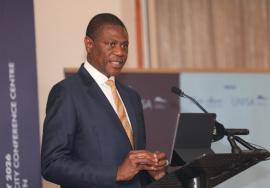
Deputy President Paul Mashatile has called for accelerated African industrialisation, stronger regional integration and an end to xenophobic violence as the continent marks 25 years of the New Partnership for Africa’s Development (NEPAD).
Speaking at the NEPAD@25 High-Level Business Breakfast in Cape Town on Thursday, Deputy President Mashatile said Africa must move beyond reflection and focus on practical implementation to achieve the goals of Agenda 2063.
The event brought together political leaders, business representatives and development partners, including former President Thabo Mbeki, one of NEPAD’s founding architects.
Reflecting on NEPAD’s launch in Abuja in 2001, the Deputy President said the initiative was created to tackle poverty, underdevelopment and Africa’s marginalisation in the global economy.
“As we mark Africa Month and celebrate 25 years of NEPAD, we return to that founding vision: an integrated, prosperous and peaceful Africa, driven by its own citizens,” he said.
He condemned recent attacks on foreign nationals in South Africa, describing anti-migrant violence as “shameful” and inconsistent with the country’s values.
“While acknowledging concerns about illegal foreign nationals involved in crime, we strongly condemn the anti-migrant protests and xenophobic violence,” he said, adding that criminality should be addressed through lawful means rather than mob action.
The Deputy President said the African Continental Free Trade Area (AfCFTA) presented a major opportunity to reshape Africa’s economy through increased trade, industrialisation and regional value chains.
He noted, however, that intra-African trade still accounts for only around 15% of total trade on the continent.
“Africa cannot continue exporting raw materials while importing finished products at a higher value,” Deputy President Mashatile said. “This model exports jobs, industrial capacity and opportunity outside the continent.”
He stressed that infrastructure investment would be critical to Africa’s future growth, highlighting transport systems, ports, energy networks and digital connectivity as priorities.
“Regional integration cannot exist without modern infrastructure,” he said. “Without reliable energy, industrialisation cannot occur at scale.”
He warned that energy insecurity and infrastructure deficits continued to undermine manufacturing and economic competitiveness across Africa, while renewable energy investment remained too low compared to global levels.
The Deputy President called for reforms to global financial institutions such as the International Monetary Fund and World Bank, saying Africa needed fairer representation and financing models suited to the developmental realities of the Global South.
As chair of the African Union’s Agenda 2063 Ministerial Follow-up Committee, the Deputy President said South Africa would use its leadership role to accelerate implementation of the continent’s long-term development blueprint during the current “Decade of Acceleration” running from 2024 to 2033.
He said South Africa’s automotive sector, renewable energy transition, mineral beneficiation capabilities and digital economy could support broader regional industrial expansion.
The Deputy President also linked development to peace and stability, referencing his role as South Africa’s special envoy to South Sudan and calling for peaceful resolutions to conflicts across Africa and globally.
He extended South Africa’s call for peace to the wars involving Russia and Ukraine, as well as tensions in the Middle East and instability in the Democratic Republic of the Congo.
Concluding his address, the Deputy President urged African leaders, institutions and investors to act urgently to build a more integrated and self-sufficient continent.
“Now is the time to build on the native land,” he said. “Not tomorrow, not next year, but now.” – SAnews.gov.za


