


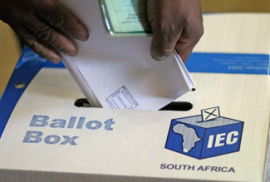
Cooperative Governance and Traditional Affairs Minister Velenkosini Hlabisa, says government has intensified preparations for the 2026 Local Government Elections scheduled for 4 November 2026.
Delivering the 2026/27 Budget Vote for Cooperative Governance and Traditional Affairs in Parliament on Wednesday, Hlabisa said several key milestones had already been achieved to ensure the polls are conducted smoothly.
These include the establishment of an Inter-Ministerial Committee on Municipal Elections, the finalisation of councillor numbers, delimitation of 4 488 wards nationally, and ongoing voter registration work by the Electoral Commission of South Africa.
Hlabisa said government remained committed to ensuring that the elections uphold democratic principles and public confidence.
“The key principle guiding us is simple: the elections must be free, fair, credible, and beyond reproach,” he said.
The Minister said preparations are progressing steadily through collaboration between government departments and electoral authorities ahead of the nationwide municipal polls.
The Minister stressed that capable municipalities are essential for a capable state, warning that local government institutions cannot not function effectively where appointments are irregular, leadership is unstable, and accountability is weak.
Government is therefore strengthening competency-based recruitment, the professionalisation of municipal administration, performance management systems, and ethical leadership.
Hlabisa tabled a combined R423.4 billion budget for the Department of Cooperative Governance and Traditional Affairs for the 2026/27 financial year. Of the total allocation, R422.5 billion has been earmarked for Cooperative Governance, while R900 million will go towards Traditional Affairs.
Traditional Affairs reforms
On Traditional Affairs, Hlabisa said government continued to address the Constitutional Court ruling through the Traditional and Khoi-San Leadership Bill of 2025, which has now been introduced in Parliament.
In June last year the Minister welcomed the Constitutional Court’s ruling to extend the validity of the Traditional and Khoi-San Leadership Act (TKLA) for an additional two years, allowing more time to finalise replacement legislation.
READ | Minister welcomes Constitutional Court’s decision on Leadership Act
“Progress is also being made on recognition of Khoi-San communities; strengthening customary governance; and integrating traditional leadership into development planning,” the Minister said on Wednesday.
On customary initiation, the Minister said government remained committed to achieving zero fatalities linked to customary initiation practices, emphasising that no cultural practice must result in loss of life.
“We are strengthening regulations, enforcement, and accountability. We are also exploring stronger legal consequences for negligence,” Hlabisa said.
Hlabisa said government is also strengthening the role of traditional leadership in governance through participation in development planning, structured collaboration with municipalities and alignment with the revised White Paper.
“Development in rural areas will not succeed without this partnership,” he said. – SAnews.gov.za


