


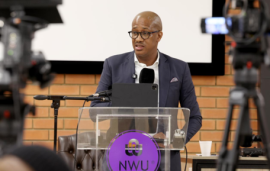
The role of the media in society remains vital, with the government continuing its work to ensure a free, independent, and thriving media sector, Deputy Minister in the Presidency Kenny Morolong said.
Morolong said the media landscape today is very different from what confronted the country in 1994.
In his closing remarks at the two-day North West Media Sustainability and Collaboration Summit held in Mahikeng, Morolong said the landscape and power resided in the hands of a few powerful media houses, allowing them to shape the media agenda.
“Today the print media is a shadow of its former self, and many former staple publications have either vanished or are only available online,” he said on Friday.
He added that, similarly, the South African Press Association, known as SAPA, which for many decades was a mainstay in the news industry, closed shop as the industry changed and evolved.
“This closure paved the way for others to fill the void, and I am pleased to say that SAnews, the government news agency run by the GCIS [Government Communication and Information System], has steadily emerged as one of the most trusted sources of government news,” the Deputy Minister said.
In its 2024–2025 Annual Report, the Media Development and Diversity Agency (MDDA) noted that despite having invested more than 20 years into community media development initiatives, research indicated that merely 7% of respondents in the sector perceive their organisations as being sustainable, with 74% of respondents identifying as partially sustainable.
“The MDDA Annual Report also notes that community radio outperformed community television, as well as community and small commercial print, in terms of sustainability, while also highlighting challenges faced by the sector, including funding limitations, a shortage of skilled personnel, restricted access to advertising, and infrastructure.
“I can assure you that the survival of the community media sector has been at the forefront of various administrations since 1994.
“In support of this noble cause, the MDDA has funded 586 community media projects, consisting of 321 radio/television stations and 185 print projects (newspapers, magazines, small commercial print.
“GCIS continues to work with the MDDA, which is responsible for promoting media development and diversity,” he said.
In addition, the MDDA continues to strengthen its role as an enabler of credible, community-driven media that empower voices, promote democracy, and support national development priorities.
Meanwhile, the Deputy Government Spokesperson William Baloyi applauded the organisers of the summit for prioritising community media and thanked the North West University for availing their facilities for this important event.
“The government of South Africa has elevated community media in its policies. The GCIS has developed a Draft Media Buying Policy that was presented to stakeholders.
“One of the key tenets of the policy is to answer the question of non-adherence to the 30% advertising spent on community media. The policy is expected to come into implementation this year.”
Baloyi told SAnews.gov.za that once the policy is approved, it will make it compulsory for government departments to ensure that community media become part of the broader beneficiaries of the advertising budget.
He emphasised the importance of compliance and encouraged community media owners to ensure they comply with the necessary requirements and to feel free to approach GCIS for advice.
“Those in the community radio sector, it is important to check the ICASA [Independent Communication Authority of South Africa] requirements and also to approach MDDA for advice,” he said.
Baloyi also emphasised the centrality of community media in providing information to citizens to enable them to improve their lives while also encouraging community media to use the local language in their areas of coverage.
Speaking to SAnews.gov.za, Chairperson of the North West Media Awards, Brenda Ramokopelwa spoke of the importance of the media.
“In the future, I would like to see media being sustainable and more partnerships forged,” she said, adding that some journalists lack knowledge about the work of the MDDA.
“We need to have journalists who are supported and who are well informed about the various issues,” Ramokopelwa said.
The delegates at the summit agreed that government and local municipalities should support community media, especially when it comes to funding.
The summit was designed to unite the region's most influential stakeholders in media, communication, funding, and the private sector.
At the summit, delegates explored funding models, digital transformation, sector-wide collaboration, skills development, and audience growth with 20 expert speakers and five specialist facilitators driving each conversation.– SAnews.gov.za


