


By Dikeledi Molobela
Mokhotlong, Lesotho – In a major step toward securing water supply for South Africa’s economic heartland, the second Tunnel Boring Machine (TBM) was launched on Monday at the Polihali construction site, under Phase II of the Lesotho Highlands Water Project.
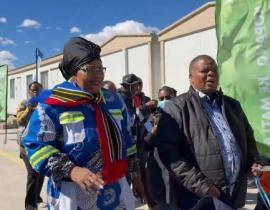
Minister of Water and Sanitation Pemmy Majodina, alongside Lesotho’s Minister of Natural Resources Mohlomi Moleko, presided over the milestone event in the highlands of Mokhotlong, underscoring deepening regional cooperation between South Africa and Lesotho.
The delegation included Water and Sanitation Deputy Minister David Mahlobo, Principal Secretary of the Ministry of Natural Resources in the Kingdom of Lesotho, Relebohile Lebeta, the Lesotho Highlands Water Commission and the Lesotho Highlands Development Authority.
The launch of the 423-metre-long TBM, designed to excavate a 38.5km tunnel connecting the Polihali Dam and Katse Dam, marks the transition from preparatory work to full-scale underground construction.
Addressing stakeholders, Majodina framed the moment as both technical and symbolic.
“Today, we stand in the highlands of Lesotho — but we gather for a journey that begins deep beneath our feet. A journey that will stretch 38.5km through solid rock, connecting the Polihali and Katse Dams into a single, gravity-driven water system — a system that will move water without a single pump.
“This is engineering at its most purposeful. This is infrastructure at its most transformative,” the Minister said.
The TBM, with a 5.38-metre cutterhead, will operate under extreme geological conditions — boring through rock beneath mountains rising over 3 000 metres and sections with up to 1 000 metres of overburden.
Once complete, the tunnel will enable water to flow naturally between reservoirs without pumping, significantly improving efficiency.
The project is critical for South Africa, particularly Gauteng, which faces growing water constraints due to rapid urbanisation and industrial demand.
“As the TBM advances, it brings us closer to the dream of a water secure Gauteng, which is the economic hub of the country and population growing rapidly despite being the smallest province in the country,” Majodina said.
The first and second TBM, which was launched at Katse in early 2025, are excavating from both ends of the tunnel to accelerate completion.
Progress to date includes more than 600 metres excavated from the Katse side and over 380 metres from Polihali, with both machines now operating simultaneously.
Beyond engineering, the project is expected to deliver substantial socio-economic benefits.
Approximately 2 400 Basotho are currently employed, with over 1 100 individuals trained and more than 700 certified in various skills. Local economic participation has already exceeded M600 million.
“This is not incidental. It is intentional. This is how infrastructure builds nations,” Majodina emphasised.
Once completed, the tunnel will increase water transfer to South Africa from 780 million cubic metres to 1 270 million cubic metres annually, while boosting hydropower generation at the Muela Hydropower Station by approximately 30%.
“This is not incremental change. This is a step-change in regional resilience for both the Kingdom of Lesotho and the Republic of South Africa,” she said.
The Minister also stressed governance and accountability in delivering the R9.2 billion project.
“Every Maloti invested, in this R9.2 billion project must deliver value to the people of Lesotho and South Africa,” she said.
The Lesotho Highlands Water Project, a long-standing bi-national initiative, is designed to harness the Orange–Senqu River system to augment water supply to South Africa while generating hydropower for Lesotho.
Phase II includes the Polihali Dam, the transfer tunnel, Senqu Bridge and associated infrastructure such as bridges, roads, and social programmes.
Looking ahead, one of the most technically demanding aspects of the project will be the “lake tap” a controlled underwater breakthrough into the Katse reservoir requiring precise alignment and pressure management.
“Let this Tunnel Boring Machine stand as a signal: That we are moving forward. That we are building. That we are delivering. Delivering with purpose. Delivering with integrity. Delivering for the people,” the Minister said. – SAnews.gov.za


