


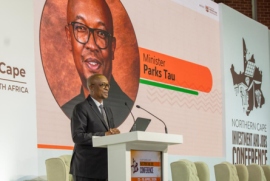
Emerging opportunities in an era where the global economy is experiencing structural changes could pave way for the Northern Cape to write a new economic story for its people.
This is according to Department of Trade, Industry and Competition Minister Parks Tau who delivered the keynote address at the Northern Cape Investment and Job Conference on Tuesday.
The province stands at the intersection of a trifecta of economic potential with its endowment of mineral resources, high levels of solar irradiation and vast open land.
“The global economy is undergoing a structural shift. The transition to clean energy is an economic inevitability.
“The demand for critical minerals is the foundation of the technologies that will define the next industrial era. And the race for green hydrogen is no longer speculative — governments and corporations across Europe, Asia and the Americas are committing billions to secure supply chains. The Northern Cape sits at the intersection of all three: namely clean energy, critical minerals and green hydrogen.
“Certainly, this province has the land, the sun and the wind to become one of Africa's pre-eminent renewable energy production zones. Through Boegoebaai and the Green Hydrogen Commercialisation Strategy, it has the infrastructure anchor to build a hydrogen economy of genuine scale. These are live policies and programmes with government commitment and investor interest behind them,” Tau said.
The province stretches some 372 000km and has the smallest population – making it an ideal destination for technological use.
“Beyond energy, the Northern Cape’s vast open spaces, low population density and potential water access through desalination make it an ideal destination for data centres — among the fastest-growing infrastructure investment categories globally.
“And agriculture, particularly in raisins, table grapes, dates and protein crops, remains a strong foundation with significant room for agro-processing and value chain development,” Tau added.
These opportunities, the Minister added, “add up to a new economic story for this province”.
“This is a story of industrialisation, not extraction. Value addition, not raw throughput. Long-term sustainable growth, not dependence on commodity cycles.
“To show that we are serious about making an impact, this story is bringing together a partnership not seen in South Africa’s history,” he said.
Three-pronged strategy
Tau told delegates at the conference that the department’s industrialisation drive in South Africa continues around three themes: Decarbonisation, Diversification and Digitalisation all of which “align almost precisely with where the Northern Cape's competitive advantages lie”.
“The [European Union’s] Carbon Border Adjustment Mechanism is already changing the calculus for South African exporters. Our response is to position our industrial base as a low-carbon production platform. Green hydrogen, green steel and battery storage are sectors where the Northern Cape’s feedstock advantages allow us to compete.
“The Just Energy Transition Investment Plan is mobilising capital for exactly this shift. This is how we decarbonise,” he said.
Turning to Diversification, the Minister stated the South Africa is looking elsewhere, “building manufacturing value chains beyond our traditional strengths”.
“Rather than exporting manganese ore, we want to export manganese products. Rather than exporting iron ore, we want to export steel. The logic of beneficiation is clear, and the Northern Cape's mineral endowment makes it a natural site for that industrial deepening.
“The Industrial Development Corporation (IDC) and our Special Economic Zones (SEZ) programme are the institutions and instruments we are deploying to make that happen. In relation to the unilateral imposition of tariffs, by some countries, we are also diversifying our trading partners.
“We are building new networks across the world and leveraging from our Global South partners. We are doing this derisking while continuing to strengthen the relationships we have with our traditional partners,” Tau explained.
He noted that in terms of Digitisation, South Africa’s infrastructure requirements for the digital economy, namely power, land, connectivity, overlap with what the Northern Cape can offer.
“Data centres create skilled jobs, require local supply chains, and build the platform for broader digital industrialisation. The Northern Cape has the conditions to lead that story.
“These three pillars of our industrial policy are simultaneous and mutually reinforcing. An investment in green hydrogen here is a decarbonisation investment, a diversification investment, and a digital infrastructure investment. That convergence is precisely what makes this province so strategically compelling right now,” Tau said.
Removing barriers, building partnerships
Prior to the opening of the main conference, the provincial government opened the One Stop Shop facility in Kimberley – designed to clear the ease of doing business and reduce regulatory red tape for investors both at home and abroad.
“Yesterday's launch of the One-Stop-Shop by InvestSA…is a practical commitment to making investment facilitation faster and more responsive.
“As you know, investors do not want to navigate multiple government departments. Instead, they want a single point of contact, clear timelines, and a system that treats their capital and their time with respect. In this regard, the dtic is committed to making this instrument work for the Northern Cape,” Tau reflected.
He called on investors to join government in driving the economy towards prosperity – citing the green shoots of reform as an indication of a country moving forward.
“No province transforms its economy through government action alone. As you would agree, South Africa is in a different moment to where we were two years ago.
“The energy crisis that constrained investment confidence has been resolved. Operation Vulindlela II is driving structural reform. And the national investment drive has secured over R1.5 trillion in investment pledges during the previous cycle, with a meaningful portion now flowing into production. Of course, our ambition is to attract a further R3 trillion over this next cycle as announced by President Cyril Ramaphosa.
“This conference is the provincial expression of that national commitment. The sectors on the agenda here – renewable energy, green hydrogen, critical minerals, agriculture, data infrastructure – are exactly where South Africa needs to build new industrial capacity,” the Minister urged.
He reiterated the outcomes of South Africa’s G20/B20 Presidency to bring together government and business to “realise the Northern Capes potential and position it as South Africa’s next economic frontier”.
“We will be partnering with the private sector together with the Premier, across all three spheres of government, and in a number of sectors including critical minerals, renewable energy and new energy technologies to realise the full potential of this great province.
“Indeed, the Northern Cape's people have waited for the economic transformation that geography and geology have always promised. This conference may well be the moment when that story decisively accelerates,” Tau concluded.
At the start of the conference on Monday, Northern Cape Premier, Dr Zamani Saul, said he looks “forward to … presenting the Northern Cape as a province of real potential and real partnerships.
READ | Northern Cape woos investors to expand and create jobs opportunities
– SAnews.gov.za


