


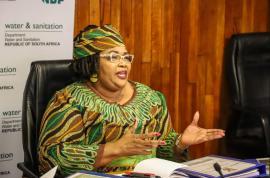
Water and Sanitation Minister Pemmy Majodina and Eswatini’s Minister of Natural Resources and Energy Prince Lonkhokhela Dlamini are set to formally sign the Revised Treaty on the Development and Utilisation of the Water Resources of the Komati Basin at Maguga Dam, in the Kingdom of Eswatini.
The signing ceremony, scheduled for Friday, 13 March 2026, aims to strengthen bilateral relations between the two countries while enhancing cooperation on the management of shared water resources.
The meeting will also focus on strengthening river flow monitoring in the Komati Basin, which is shared by South Africa and Eswatini, and ensuring compliance with statutory water flow obligations to Mozambique.
Department of Water and Sanitation spokesperson Wisane Mavasa said the revised treaty marks a new chapter in the sustainable development and management of the water resources of the Komati River Basin.
“The revised Treaty will unlock Phase Two developments to enable the Member States (South Africa and Eswatini) through the Komati Basin Water Authority (KOBWA) to venture into future Komati Basin dam projects and undertake revenue generation initiatives to benefit the citizens of the two countries and to ensure financial sustainability, and reduce its dependency on the Member States,” Mavasa said in a statement on Thursday.
KOBWA was established in 1992 as a bi-national institution through a treaty between South Africa and Eswatini to implement Phase One of the Komati River Basin Development Project.
Phase One included the design, construction, operation, and maintenance of the Driekoppies Dam in South Africa and the Maguga Dam in Eswatini. While the first phase has been completed, Phase Two has not yet been conceptualised.
The Komati River Basin is a transboundary water system shared by South Africa, Eswatini, and Mozambique. It comprises the Mlumati and Komati rivers, which later join the Crocodile River downstream.
South Africa and Eswatini share water from the Maguga Dam on a 60/40 basis, while the Driekoppies Dam is solely used by South Africa. – SAnews.gov.za


