


While government’s efforts to support economic recovery are gaining momentum, more need to be done to significantly reduce unemployment.
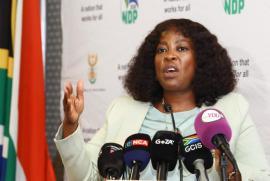
This is according to the Minister in the Presidency for Planning, Monitoring, and Evaluation, Maropene Ramokgopa.
“South Africa is making progress, but more must be done to ensure economic recovery translates into jobs, income, and improved well-being for all,” the Minister said on Friday in Pretoria.
She was providing an update on government’s performance against the Medium-Term Development Plan (MTDP) 2024–2029 for the period April to September 2025, which measures performance against government’s priorities for the seventh administration.
They include driving inclusive economic growth and job creation; reducing poverty and tackling the high cost of living; and building a capable, ethical, and developmental state.
Government has achieved a primary budget surplus, signalling its commitment to fiscal discipline.
In addition, Operation Vulindlela has played a critical role in removing structural constraints to economic growth.
“During the reporting period, progress has been reported in energy reforms, logistics and water infrastructure coordination. This has contributed to improved system performance and greater private-sector investment confidence,” Ramokgopa said.
She noted that South Africa recorded 0.8% Gross Domestic Product (GDP) growth in the second quarter (Q2) of 2025, the strongest quarterly performance since 2022, despite global economic volatility.
“The unemployment rate declined by 1.3 percentage points to 31.9%, with 248 000 jobs added in the third quarter (Q3) 2025. However, youth unemployment remains extremely high at 58.5%, signalling deep structural labour market challenges.
“Poverty and inequality remain entrenched, with a Gini coefficient of 0.63. South Africa is making progress, but more must be done to ensure economic recovery translates into jobs, income, and improved well-being for all,” the Minister said.
South Africa’s exits from the Financial Action Task Force (FATF) grey list after successfully implementing key reforms to combat money laundering and the financing of terrorism has improved investor confidence.
Ramokgopa highlighted key sectors that continue to show progress.
These include R44.2 billion in new investments that were secured across sector masterplans, the automotive sector saw launch of BMW X3 Plug In Hybrid Electric Vehicle, backed by a R4.2 billion investment and battery minerals pipeline is valued at R40 billion.
In the Micro, Small, and Medium Enterprise (MSME) and informal economy, 45 105 jobs were created, and 41 753 were sustained through MSME programmes.
“In tourism, international arrivals increased to 7.6 million between January and September 2025. Tourism visa reforms are underway through the Electronic Travel Authorization (ETA) system
“In terms of energy security, more than 175 consecutive days without load shedding were recorded in the reporting period. The Energy Availability Factor improved to 63.29%, reaching 70% on several days,” she said.
Infrastructure
Government has set aside R1.03 trillion for public infrastructure over the Medium-Term Expenditure Framework (MTEF).
The Minister emphasised that infrastructure investment remains a key lever for inclusive growth in the country.
“The Infrastructure Fund has approved 26 blended finance projects worth R101.6 billion. The Budget Facility for Infrastructure (BFI) approved 10 major projects worth R37.1 billion for implementation.
“Despite this momentum, delays persist due to municipal capacity constraints, procurement inefficiencies, and inadequate project preparation.
“High municipal debt levels (94.6 billion rand as at March 2025) pose risks to infrastructure sustainability. Grid expansion delays also threaten future energy security, despite recent improvements,” she said.
Local government performance
According to the Minister, work continues to strengthen the performance of local government as financial challenges in municipalities persist.
“An Inter-Ministerial Committee has been established to support distressed municipalities. Local government reforms are being introduced through the review of current legislative and regulatory framework with the development of a White Paper on Local Government (LGWP).
“The Presidential Working Group has also been established to support Metros, including the implementation of the Metro Trading Service Reform Programme,” she said. - SAnews.gov.za


