


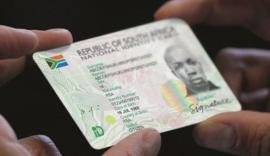
Government has in a statement on Tuesday corrected claims that the Department of Home Affairs’ partnership with banks on Smart ID cards is “new and driven by a political party”.
A statement issued by the Government Communication and Information System (GCIS) on Tuesday said the partnership with the banks was started as part of the multi-channel access model to increase the Department of Home Affairs’ footprint.
The Department of Home Affairs on Sunday officially entered its live operational phase, allowing people to apply for Smart ID cards directly at participating bank branches.
Through the programme, South Africans can complete a secure Smart ID application at selected bank branches within minutes using integrated digital systems.
The system allows banks to connect directly to the department’s systems through a secure digital gateway, enabling applications to be processed within 5 to ten minutes without completing paper forms or making prior bookings.
Instead of travelling long distances to one of the country’s 349 Home Affairs offices, applicants will be able to access services at bank branches in their communities.
“The Smart ID digitisation programme was initiated in 2015 under the then Minister of Home Affairs, Dr Malusi Gigaba, as part of government’s broader efforts to modernise the national identification system and enhance service delivery.
“At the time of its launch, the partnership included ABSA, FNB, Nedbank and Standard Bank and Investec. Discovery Bank joined in 2019 under the then Minister of Home Affairs Dr. Siyabonga Cwele,” said GCIS in its statement.
GCIS said the collaboration with banks forms part of the government’s multi-channel access model aimed at expanding the Home Affairs service footprint and making digital ID services more accessible to citizens across the country through the use of bank staff.
The initiative with banks is regulated by Memoranda of Understanding signed between Department of Home Affairs and the banks.
The security guarantees are assured because the ABIS database has the biometrics to ensure that no photo swaps can be facilitated at banks, said the GCIS.
There were 30 bank branches that participated in this initiative before the recent joining of Capitec to the programme. These branches were spread as follows: Gauteng (17), Western Cape (5), Eastern Cape (2), KwaZulu-Natal (3), Mpumalanga (1), Limpopo (1) and Northern Cape (1).
Government said it welcomed that Capitec has ultimately joined the initiative, under Dr Leon Schreiber, the current Minister of Home Affairs, and the upgrading of technologies in banks such as Standard Bank and FNB and the progression to the stage of applications being done at the banks.
“The advancement of this system will support government’s initiative to eradicate the green-barcoded ID books and move South Africans to a more fraud-proof digital IDs,” said the GCIS. – SAnews.gov.za


