


By Sihle Manda
South Africa’s railway sector has its work cut out if it is to contribute meaningfully to the elimination of some of the country’s prevailing challenges.
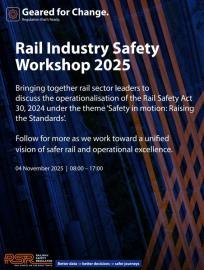
This was on Tuesday conceded by the Railway Safety Regulator (RSR) Chief Executive Officer (CEO) Brian Monakali while addressing the Rail Industry Workshop on Tuesday, in Melrose Arch, in Johannesburg.
The regulatory mandate of the RSR involves overseeing railway operations to ensure public safety, enforcing safety regulations, and developing a framework for safe practices. This includes issuing safety permits, conducting inspections and audits, investigating accidents, and having the authority intervene in unsafe situations by issuing directives or suspending operations.
Taking place under the theme of: “Safety in Motion: Raising the Standards”, Monakali said the workshop was taking place amid the country’s rail safety performance not being where it ought to be. This, he said, contributed to the challenges that continue to hamstring the country.
He said: “We are aware of the challenges that the country is facing - poverty, unemployment, crime and [low] economic growth - that is not where we want it to be. Rail is contributing to these challenges.
“Safety performance is not where we want it to be. We still have a lot of cargo being moved by road; a lot of people are still using the road to commute,” said the CEO.
The industry is also contending with sustainability issues that include climate change, the cost of doing business, and safety risks, among others.
Monakali said all these issues affect the country’s global competitiveness.
“Our role is to ensure that we lower the cost of doing business for customers and clients. Some of you had a choice of where to mine your product; here in South Africa or anywhere else in the world.
“You had a choice, and one of the determining factors was the cost of doing business. Some of you had a choice of where to sell your products or services. Passengers also have a choice as to which mode of transportation to use. All those choices have an impact on this country. We need to raise the bar so that we can really improve this country’s competitiveness.”
As a country, he said South Africa has aspirations that have been put to the regulator. These include having to move 250 million tonnes of freight rail by 2030 and almost 600 million passengers by the same year.
“That is a big, big ask. Our government – together with business – has already started to implement some of the key initiatives. One of them is focusing on the recovery of safety and efficiency operations,” he said.
“We have seen the RFIs that have been issued for both freight and passengers to encourage private sector investment and allocation to additional operators.
“We have the initiatives. The question for us today is: how do we achieve all of this safely? How do we achieve a safe recovery? That is very, very important. How do we achieve this in a way that we do not injure people and no person dies and our assets are safe? That is why we are here,” he said.
He emphasised that safety has got a direct impact on efficiency.
“When you have derailments, collisions, stopages, you are unable to have an efficient system,” he said.
In December 2024, President Cyril Ramaphosa signed the Railway Safety Bill into law. The new Railway Safety Act 2024 replaced the 2002 Act to improve railway safety regulations by providing for railway safety permits, a national information and monitoring system, and stronger enforcement measures. It also includes provisions for worker representation on the board of the Railway Safety Regulator. -SAnews.gov.za


