


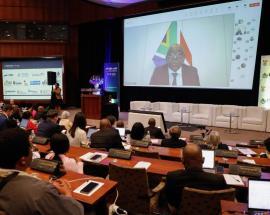
Science, technology, and innovation hold the key to shaping inclusive, just, and sustainable societies – and global leaders must recognise their transformative power, says Minister of Science, Technology and Innovation.
Nzimande was speaking during his keynote address at the 9th Biennial Conference, held under the theme “Science, Technology, and Innovation for a Sustainable Future.”
He urged policymakers, scientists, researchers, and innovators to ensure that advancements in these fields serve the public good, promote social justice, and respond to the needs of both people and the planet.
“As policy makers, scientists, researchers, and innovators, we carry a huge responsibility to ensure that science, technology and innovation serve the public good, advance social justice and contribute to a more equitable and sustainable future.
“It is, therefore, my sincere hope that you will see this conference as an opportunity to strengthen our resolve to harness science, technology and innovation not only to build knowledge systems that are inclusive, ethical, but also responsive to the needs of our planet and its people,” Nzimande told the attendees.
The session was held in collaboration with the Global Sustainable Technology and Innovation Community (G-STIC), an initiative led by the Belgian Research and Technology Organisation (VITO).
Hosted by the Council for Scientific and Industrial Research (CSIR), the gathering coincides with the entity’s 80th anniversary, celebrating its positive impact through innovation.
In addition, he stated that the African continent cannot afford to be left behind in the ongoing artificial intelligence (AI) revolution occurring globally.
“A sovereign research agenda will ensure that Africa does not fall into the trap, as was the case with previous technological revolutions, of being reduced to mere importers and consumers of other people’s AI solutions.”
He believes that the development of a sovereign research agenda for Africa is critical.
“As the African continent, we do not want a repeat of the tragedy we experienced during the global outbreak of the COVID-19 pandemic, when the lives of millions on our continent were dependent on the vaccines from other parts of the world.”
As the threat to multilateralism increases due to the aggressive tactics of certain countries and the ongoing genocide in Gaza, he emphasised that the lessons learned from these challenges indicate that no country can address these issues in isolation.
“Also, more than ever before, we must be intentional about mobilising all the available scientific knowledge in the world, to develop sustainable responses to the challenges of our time.”
Nzimande also took the time to congratulate the leadership and staff of the CSIR on their milestone of 80 years.
“Formed in 1945, the apartheid government used the CSIR as part of its oppressive machinery to, among others, produce weapons to commit all manner of atrocities against our people in South Africa and parts of the African continent.
“With the advent of democracy, the democratic government repositioned CSIR to play a more progressive role in society and for it to use its research and scientific capabilities for the development of our country and continent,” he explained.
In alignment with the government’s strategic priorities, the CSIR has played a crucial role in advancing key sectors such as health, defence, energy, mining, manufacturing, digital innovation, and supporting small, medium, and micro enterprises (SMMEs).
“I am proud to state that the CSIR plays a profoundly progressive role in our country’s development agenda and continues to be one of the most well-run public institutions in our country.” – SAnews.gov.za


