


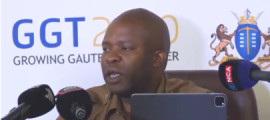
Gauteng MEC for Education, Lebogang Maile, has outlined a series of interventions aimed at addressing severe overcrowding in the province’s schools, as learner numbers continue to surge beyond available capacity.
Addressing Gauteng residents on Tuesday, Maile said the province is implementing a combination of infrastructure expansion, partnerships and short-term relief measures to respond to the growing demand for school spaces.
“Today, we want to provide an overview of the state of learner enrolment in Gauteng as of 2026, looking at overcrowding in our schools, the state of infrastructure and the interventions that have been put in place by the Gauteng Provincial Government to address the challenges,” he said.
The province’s education system is under increasing strain, with learner enrolment more than doubling over the past three decades.
“In 1995, the province had 1 408 237 learners in its schools – a number that has increased to 2 835 168 as of 2026,” Maile said.
This rapid growth, driven by migration and urbanisation, has resulted in nearly half of Gauteng’s public schools operating above capacity. Of the 2 111 schools in the province, 1 021 are over-subscribed, representing 48%.
“Nearly all districts are affected by this reality, indicating that the issue is wide-spread and systemic rather than prevalent in just a handful of districts,” he said.
The pressure is particularly acute in township and urban areas, where population density and economic activity continue to attract new residents.
Against this backdrop, Maile outlined several interventions underway to ease overcrowding and expand access to education.
A key focus is the construction of new schools and the replacement of ageing infrastructure. Government has allocated R3.982 billion over the Medium-term Expenditure Framework (MTEF) for school infrastructure.
“The total budget for both new and replacement schools over the Medium-term Expenditure Framework (MTEF) amounts to R3.982 billion, which allows for the construction of approximately seven new schools each year and 23 in total over the MTEF,” he said.
To accelerate delivery, the Gauteng Department of Education is working with strategic partners.
“We are working with the Development Bank of South Africa (DBSA) on projects geared towards the construction of new and replacement schools in high pressure areas,” the MEC said.
In addition, the province has launched the Budget Facility for Infrastructure (BFI) Schools Programme in partnership with the Gauteng Infrastructure Financing Agency.
“This comprises 18 projects on greenfield sites across all municipalities in the province,” Maile explained.
Government is also exploring alternative delivery models to fast-track infrastructure rollout.
“We are also exploring the public-private partnership infrastructure delivery model as a viable solution to address the backlog,” he said.
In the short-term, authorities are implementing measures to immediately relieve pressure on overcrowded schools. These include the expansion of existing facilities and the use of temporary classrooms.
“Through the Self-Build Programme, the Gauteng Provincial Government has also introduced an additional classroom programme that in essence provides for schools to manage the construction of additional classrooms.
“Whilst not desirable, we are currently also supplying prefabricated temporary classrooms to alleviate the increasing pressure while awaiting the completion of a brick-and-mortar facility,” Maile said.
The province is also considering repurposing existing infrastructure to increase capacity.
“We are also exploring buying privately owned former missionary schools that are still in a good condition and comply with regulations, norms and standards,” he said.
Long-term planning is another critical pillar of the intervention strategy. The provincial government has developed a 20-year infrastructure plan to better align school development with population growth and urban planning.
“The Gauteng Provincial Government has a 20-year Plan for infrastructure that centres a formulated infrastructure planning framework for the Gauteng Department of Education,” the MEC said.
This includes plans to build schools in new mega human settlement developments and in inner-city areas.
However, Maile acknowledged that infrastructure delivery continues to face significant challenges, including budget constraints, vandalism, project delays and rapid population growth.
“Our Infrastructure Delivery Model also faces critical challenges including severe project management incompetence, rampant vandalism, and disruptions,” he said.
Despite these constraints, the provincial government says it is committed to addressing overcrowding through coordinated interventions and stakeholder collaboration.
“The Gauteng Provincial Government is prioritising a combination of interventions that are aimed at resolving education infrastructure delivery delays to address over-subscription which leads to school overcrowding,” Maile said.
Maile called on communities and the private sector to support government efforts, particularly in protecting school infrastructure from vandalism and disruption.
“We urge parents and the public to assist the government in protecting schools. Working with law enforcement, the public must play a meaningful role in guarding against education infrastructure vandalism, theft, and school construction site disruptions that are being carried out by forums that are undermining the future of our children.
“We must all work to ensure that the limited resources in education are utilised optimally, efficiently and effectively,” he said.
As learner numbers continue to rise, the success of these interventions will be critical in ensuring that Gauteng’s education system can meet demand while maintaining quality and access for all learners. – SAnews.gov.za


