


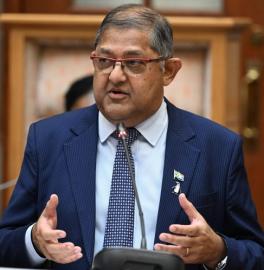
Deputy Minister of Forestry, Fisheries and the Environment Narend Singh has emphasised that affordable finance to support a just transition and build climate resilience remains a critical enabler for developing countries as they navigate a complex global environment that could reshape mitigation strategies.
Singh was addressing the international community virtually at the Inclusive Forum on Carbon Mitigation Approaches (IFCMA), where he expressed concern about the climate response of developing nations, many of which are facing fiscal constraints due to debt-servicing costs.
“Due to the ongoing geopolitical tensions, fragmentation of international trade and investment flows, and persistent uncertainty, it is recognised that countries may recalibrate climate mitigation strategies to balance an increasingly complex set of policy objectives, including energy security, industrial competitiveness and strategic autonomy,” Singh said.
He said that as governments around the world pursue different approaches in responding to these emerging issues, new international spillovers may arise, with implications for greenhouse gas emissions, carbon leakage, trade and investment patterns, sustainable and inclusive economic growth, incentives to innovate, and technology diffusion.
“The imposition of high trade tariffs and reciprocity measures imposed by some countries invariably has impacts on others, particularly exporting countries, at the domestic level.
“Entire value chains have been impacted. Many business operations have been disrupted, whilst they are grappling with soaring input costs such as fuel and fertilizers,” the Deputy Minister said.
He added that policies such as the Carbon Border Adjustment Mechanism (CBAM) have also affected exports of certain commodities, particularly in developing countries such as South Africa, which are still transitioning to an inclusive, climate-resilient, low-carbon economy.
CBAM is the European Union’s (EU) levy on emissions embedded in imported products, which makes it more expensive for companies to emit greenhouse gases. It intends to encourage cleaner industrial production in non-EU countries.
“In a developing country context, we also need to be cognisant of the need to develop new skills across value chains, recognise funding gaps, mobilise necessary capital investment, and ensure that the supporting infrastructure is equally enabling to grow the economy sustainably and inclusively.
“Moreover, engagement with affected stakeholders and communities to ensure awareness and buy-in on required policy shifts and to identify capacity building requirements associated with the just transition is of paramount importance. The potential opportunities that can be created through the transition also need to be communicated,” Singh said.
The Deputy Minister said identifying risks and challenges is key to understanding what measures need to be put in place and what opportunities these may create.
He pointed out that South Africa has taken several steps to create an enabling policy environment that will facilitate the transition of the economy in a manner that is low-carbon, inclusive and climate resilient.
South Africa’s Climate Change Act was promulgated in 2024 to guide the country’s just transition to a low-carbon, climate-resilient economy.
“We have consulted with companies, which trigger in excess of 30 000 tonnes of carbon emissions equivalent (CO2 eq.) per annum, in preparing companies for the Carbon Budget Regulations.
“Companies need to put mitigation plans in place and report on progress on an annual basis. This is a significant intervention in transitioning the industry in reducing emissions,” Singh said.
Furthermore, the national government has been working closely with other spheres of government, particularly local government, to undertake risk and vulnerability assessments and assist municipalities with developing climate change response plans.
“The end goal is to enhance adaptive capacity and build climate resilience. Recently, the Department of Trade, Industry and Competition, launched the Industrial Development Strategy (IDS) for South Africa,” he said.
The objective of the strategy is to support the decarbonisation of industry through the uptake of cleaner technology and new energy systems, as well as economic diversification through beneficiated value chains and digitalisation.
“Product and market diversification is a long-term goal. By the same token, we must also ensure inclusivity and, in this regard, small businesses need to be part of the solution.
“As South Africa, we remain committed to the targets as set in the 2025 updated Nationally Determined Contribution (NDC), and the implementation of the Climate Change Act of 2024. We look forward to developing and nurturing enabling partnerships both internationally and domestically to support these important processes,” the Deputy Minister said. -SAnews.gov.za


