


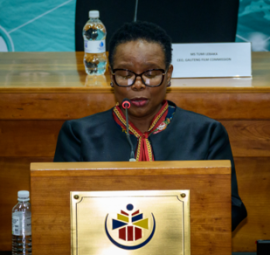
Artificial intelligence (AI) must be used to expand opportunities for women beyond newsrooms, universities and technology companies, particularly women in rural communities who often face barriers to accessing information, skills and digital opportunities.
This was the message from Government Communication and Information System (GCIS) Chief Director: Products and Platforms, Zanele Mngadi, who said the digital revolution must be harnessed to improve women’s lives wherever they live.
Mngadi was speaking during the Tshwane University of Technology (TUT)/GCIS Women in Media and Communications Panel Discussion, on Wednesday.
The session was held under the theme: “Coded for Equality: Women, AI and the New Media Landscape.”
As South Africa continues to mark Women's Month, which commemorates 70 years since the historic 1956 Women's March to the Union Buildings, Mngadi said the country must confront the challenges posed by rapidly evolving technology while ensuring that women are not left behind.
She said the conversation about AI should not only focus on its potential impact on women's careers, but also on how women can use technology to create opportunities for other women.
“How can we use these tools to make information more accessible to a woman in a rural village – in her own language and through a platform she can access?
“How can we connect her more effectively to information about healthcare, education, agricultural support, business opportunities, government services or protection from gender-based violence?” Mngadi asked.
She said the digital transformation must also ensure that rural women's voices and lived experiences are reflected.
“How do we ensure that her voice and lived experience are present in the stories we tell and the information environment we are building? That, for me, is where technology becomes more meaningful.
The Chief Director said AI can be a powerful tool for inclusion.
“In the hands of women journalists and communicators, AI can become a powerful tool for inclusion, enabling us to deliver credible and useful information further, faster, in more languages and in forms that speak to the realities of women wherever they live,” she explained.
Access
Her comments come as government works to address the country's digital divide through initiatives such as SA Connect, which is aimed at expanding broadband connectivity and community Wi-Fi, particularly in underserved communities.
Mngadi said access remains fundamental to ensuring that women can participate meaningfully in the digital economy.
“Statistics South Africa has also documented gender disparities in access to and use of information and communication technologies. This matters because participation in the AI economy begins with access: access to technology, skills, information and opportunity,” she said.
Through the National Digital and Future Skills Strategy, government is also investing in the skills needed to enable South Africans to participate in the digital economy, while initiatives supporting women and girls in technology are creating pathways into STEM (Science, Technology, Engineering and Mathematics), innovation and entrepreneurship.
Neutrality and the measure of progress
Mngadi stressed that technology itself is not automatically neutral, warning that AI systems can reproduce and amplify inequalities.
“Technology is not automatically neutral. AI learns from data generated by societies with their own histories, inequalities and biases. If those biases are embedded in the data, technology can reproduce and amplify them,” she said.
For this reason, she said women must have a voice throughout the technology ecosystem – not only as users, but also as researchers, developers, journalists, communicators, entrepreneurs, policymakers and leaders.
She also challenged stakeholders to rethink how progress for women is measured.
“Our measure of progress cannot simply be how many women are present in our newsrooms, communications departments, universities or technology companies.
“It must also be how much influence women have over where these industries are going, and whether that influence improves the lives of women beyond those rooms.”
Mngadi said the GCIS-TUT partnership is important in preparing young women for a rapidly changing media and technology landscape, bringing together government, academia and the media to share expertise and strengthen digital capabilities.
She welcomed initiatives at TUT supporting women in technology, including the Girls in Tech programme and the Electronics Repair and Entrepreneurship Programme.
She also highlighted national initiatives such as the Technology Innovation Agency’s Women Technology and Innovation Programme, the National Electronic Media Institute of South Africa’s (NEMISA) training programmes and the African Girls Can Code Initiative.
Opening doors for others
At the heart of the discussion, however, was the need to ensure that technological progress translates into tangible opportunities for women who remain on the margins of the digital economy.
Mngadi said women must use their position and access to technology to help open doors for others.
“Women cannot wait for the digital revolution to deliver equality. We must help shape it and use our access to technology to open doors for other women. Our challenge is to ensure that the glass ceiling of yesterday does not become the algorithm of tomorrow.”
Misinformation and disinformation
She also warned of the growing threat posed by misinformation and disinformation, particularly as AI makes it increasingly easy to create convincing fake text, images, audio and video.
The GCIS, she said, is strengthening its response, including work towards a government fact-checking capability to proactively debunk deepfakes and false information.
For Mngadi, ensuring that women help shape the future of technology is ultimately about making sure that innovation serves society.
Quoting Lilian Ngoyi, one of the leading figures of the 1956 Women's March, she said: “Freedom does not come walking towards you – it must be won. As women we must go on playing our part.”
“Seven decades later, that call remains relevant. In this new technological era, the responsibility to advance equality is now ours.
“Let us ensure that the glass ceiling of yesterday does not become the algorithm of tomorrow, and that equality is coded into our future from the beginning,” Mngadi said. – SAnews.gov.za


