


Just as the rhythm of life is palpable in every breath that we take, that same rhythm echoes in the evolution of South Africa’s laws as they seek to reflect and adapt to the society we live in.
South Africa’s ongoing programme to rename and standardise geographical places is about far more than maps and signposts - it is a deliberate effort to reshape the country’s identity, restore historical dignity and reflect the lived realities of its people.
As government moves to strengthen the legislative framework guiding this process, the Draft South African Geographical Names Council Amendment Bill, 2026, signals a renewed push to accelerate transformation while improving oversight, public participation and accountability.
In March, the Minister of Sport, Arts and Culture (DSCAC), Gayton McKenzie, approved the publication in the Government Gazette of a notice inviting public comments on the Draft South African Geographical Names Council Amendment Bill, 2026.
The Draft Bill seeks to amend the South African Geographical Names Council Act, 1998 (Act No. 118 of 1998), in order to strengthen the governance framework of the South African Geographical Names Council (SAGNC), enhance its administrative efficiency, and improve its capacity to fulfil its statutory mandate effectively.
The Council was established under the 1998 Act as a permanent advisory body to advise the Minister responsible for Sport, Arts and Culture on the transformation, standardisation, and management of the country’s geographical names for official purposes.
The Draft Bill defines standardisation to mean the determination of the name to be applied to each geographical feature; the written form of that name; and the regulation by an appropriate authority of a geographical name, its written form and its application among other things.
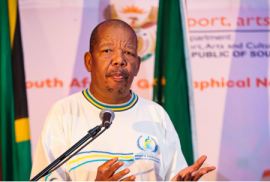
Deputy Chairperson of the SAGNC, which advises government on how the country names and renames its places, Johnny Mohlala, said the process to review the legislation began in the sixth administration.
“Well, the process began more than three years ago, in the previous administration. What necessitated the review is that there is quite a number of gaps that were identified within the current legislation and that lacuna had to be dealt with and that was the reason why the Act had to undergo a review process,” Mohlala said in an interview with SAnews.gov.za.
The mission of the Council is to standardise geographical names and in doing so, to redress, correct and transform the geographical naming system in order to advance restorative justice.
According to the DSAC, this also includes addressing the colonial and apartheid-era naming legacy by ensuring that geographical names reflect indigenous languages, cultural heritage and natural heritage work that is central to the department’s objective of fostering a shared, inclusive national identity and sense of belonging.
It is clear that this goes beyond just place names on a map whether you access your map via an app or the old school format of a map in your hand.
Mohlala described the current state of transformation and the management of South Africa’s geographical names more than three decades into democracy as rather slow.
“Well, my view is that we are moving at a very slow pace considering that since the Act was passed in 1998, we are only at some 1 500 names and I can tell you that, there are still a number of names that still need to be standardised. So, the question would then be, if we don’t move very quickly now, this may take longer than it’s actually supposed to be,” he said of the process to change the names of some of the country’s places.
He added that while there is no set target for name changes, there are some in South African society who do not embrace transformation.
“The reason would be among other things; there are quite a number of sections of the society that are simply anti-transformation. There is no set target for name changes, it’s a never-ending process. When you look at the establishment of human settlements, in the main these are controlled by town planners, and town planners might decide to call a new settlement by a particular name which may later be found to be undesirable. So, it’s a never-ending process,” he explained.
Changes
The Amendment Bill, for which the 30-day public comment period ended earlier this month, among other things, speaks to the establishment of an Appeals Tribunal for the review of decisions made in terms of name changes that have been effected.
“One of the changes will be the term of office of the Council. We profess that it must be aligned with the term of office of the Minister [of the Department of Sport, Arts and Culture] because it’s not easy for anyone to hunt with another person’s dogs so to speak.
“The Minister comes into office and finds a council operating, [he/she] has to wait for the term of that council to end before he or she can appoint [their] own council. That might not be a very desirable situation, but if the term of office of council goes with the term of office of the Minister, that is five years, then we know that after five years we know it ends, the new Minister comes in and appoints his or her own Council.”
The current Council was appointed by the Minister of the DSAC for a three-year period that started on 1 January 2025 and will conclude on 31 December 2027.
“The second thing is that we have a situation where there is a disjuncture in the sense that if a person is not satisfied with the process, the person raises an objection with the Minister who has actually gazetted the name change. So, we believe that by bringing in an appeals board or committee or a tribunal, might close that gap.”
The Bill also provides for mandatory public consultation processes and the functions and resourcing of Provincial Geographical Names Committees, among others.
The Draft Bill defines consultation as a “mandatory, multi-stakeholder engagement process conducted in good faith to solicit, consider, and incorporate informed views from relevant communities, authorities, and experts on proposed geographical names or name changes, prior to evaluation, recommendation, or approval” among others.
“Remember, one of the things that the bill seeks to address is the definition of consultation. Over the years, there has never been a definition of what constitutes consultation. Now the thing being that we’ve been through court and it was through judgements that were given by court that we have come to an understanding of what satisfies the court as sufficient consultation,” he said.
The publication of the bill comes after the January approval by Minister McKenzie of 21 geographical name changes and name registrations from the Eastern Cape and KwaZulu-Natal provinces, following recommendations from the SAGNC.
At the time, DSAC said the approvals reflect its ongoing commitment to transforming South Africa’s naming landscape, promoting social cohesion, and recognising the country’s diverse heritage.
The name changes and registrations, which included the changing of names such as Port Elizabeth to KuGompo City and Adendorp to Bishop Limba in the Eastern Cape, appeared in the Government Gazette dated 6 February 2026.
How the process works
Asked about the processes followed in changing geographical names, Mohlala said the process starts with someone filling out an application form and the form being served to Council after having gone through the Provincial Geographical Names Committee.
The Council will then assess the application and see whether it satisfies the requirements set out in the standard operating procedure.
“Once the Council has satisfied itself that the application satisfies all the requirements, Council then recommends the name for change and sends the recommendation to the Minister. At the end of the day, the Minister will then decide whether to gazette the name or not.
“The process does not end there, after gazetting, anyone who is not satisfied [with the decision] still has about 30 days to object to the name change. Even after the objection process has been finalised, one can still go to court and ask the court to arrive at a particular determination.”
The Deputy Chair said that since the SAGNC has been in operation, it has had no less than four court cases where the public has taken the Council and government to court.
“Dare I say that we’ve won all those court cases, the Nelspruit to Mbombela, the Port Elizabeth to Gqeberha, [and] Grahamstown to Makhanda.”
Asked about the negative sentiment sometimes associated with name changes, the Deputy Chairperson said the Council is “satisfied with the work that we do.”
“We are saying that name changing is a very emotive process, it’s not surprising that some people feel offended when we think we are doing the right thing. Remember the whole process started as a way of the restoration of people’s dignity as ordered by the TRC [Truth and Reconciliation Commission].
“The TRC found it necessary as part of reparation to restore the dignity of the people of South Africa. One way to do that is to that is through name changing. We are promoting that aspect as espoused in the TRC,” he explained.
Asked about whether we take name-changing exercise for granted, the Deputy Chairperson said: “Maybe we’re not doing enough in terms of public awareness.”
He also drew a stark comparison with how Germany no longer celebrates names tied to its dark history.
“We cannot continue to be a proud people if we get offended by some of the names that we see on signboards,” he said.
Freedom Month
As the country moves towards the end of the commemoration of Freedom Month, Mohlala reminded: “This freedom was fought hard for; this freedom was as a result of sacrifices where people sacrificed their lives. It was hard-earned. It did not come free. It was very expensive to get, and I must indicate that if people think that freedom is expensive, they must try war.”- SAnews.gov.za


