


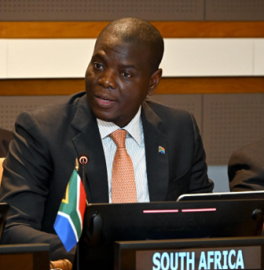
New York, USA — South Africa has called for urgent reform of the global governance system, particularly the United Nations Security Council, arguing that restoring trust in multilateralism requires Africa to have a meaningful place in global decision-making.
International Relations and Cooperation Minister Ronald Lamola said Africa could no longer remain on the margins of a system in which conflicts on the continent feature prominently on the Security Council’s agenda, while African countries remain without a permanent seat.
“In our view, restoring trust in multilateralism will not happen without meaningful reform of global governance, principally the UN Security Council,” he said.
Lamola was delivering South Africa’s National Statement during the General Debate of the 81st United Nations General Assembly (UNGA81) in New York on Thursday, under the theme “Restoring trust, managing transformation: A United Nations that delivers for all.”
He said South Africa’s history demonstrated the potential of multilateralism to deliver transformative change.
Marking Heritage Day (24 September), Lamola reflected on South Africa’s transition from apartheid to democracy and the role played by the international community.
Sixty years ago, the United Nations General Assembly adopted a resolution condemning apartheid as a crime against humanity.
Lamola said the eventual demise of apartheid not only liberated South Africans from racial domination but also helped bring an end to a system that had exported violence and instability across Southern Africa.
“Indeed, the fall of apartheid is a glorious story that attests to what multilateralism can deliver,” he said.
He said democratic South Africa had since pursued a foreign policy anchored in Ubuntu, international law, dialogue and multilateralism, while recognising that the country’s future is closely linked to that of the region and continent.
He also pointed to South Africa’s democratic record, including seven national elections since 1994, and the formation of a Government of National Unity following the 2024 elections.
“As we speak, South Africans are preparing once again to exercise their democratic right, this time in Local Government Elections. Again, the will of the people will prevail,” the Minister said.
South Africa will go to the polls on 4 November 2026.
A seat at the table
Lamola said the need for the Security Council reform is particularly urgent for Africa.
“African citizens are growing weary of their continent being consigned to the periphery of global governance,” he said.
Africa is home to nearly one-fifth of the world’s population and African countries collectively account for more than a quarter of UN Member States.
Yet, he said, over the past decade, 70% of UN Security Council resolutions had concerned conflicts on the African continent.
“If the future belongs to the young, then surely a continent that will be home to one in four of the world’s youth by 2030 deserves a bigger seat at the table,” he said.
South Africa therefore reaffirmed its support for the Ezulwini Consensus, the African Common Position on Security Council reform.
The African Common Position calls for no fewer than two permanent seats for Africa and five non-permanent seats, with the continent maintaining that any new permanent members should have the same prerogatives, including the veto for as long as it exists.
Call to resolve conflicts
Lamola said restoring confidence in the UN also required demonstrating that peaceful conflict resolution remained at the heart of the multilateral system.
“Restoring trust in multilateralism demands that we demonstrate, as the United Nations, that the peaceful resolution of conflicts is still our mantra,” he said.
He pointed to the conflicts in Sudan, the eastern Democratic Republic of Congo, Iran and Ukraine, as well as the risks faced by humanitarian workers.
Lamola said humanitarian personnel must be protected and that South Africa had endorsed the Declaration for the Protection of Humanitarian Personnel, which he said had been supported by nearly 120 states.
“To restore respect for international law, we must protect those who deliver humanitarian assistance,” he said.
Lamola said the need to uphold international law was particularly urgent in Palestine.
“Nowhere is the need to uphold our shared humanity more urgent than in Palestine. The rights, dignity and humanity of Palestinians cannot be treated as conditional,” the Minister said.
He said South Africa remains committed to its position on Israel’s conduct in Gaza and called for international action, while reaffirming support for a negotiated two-state solution based on United Nations resolutions.
“The State of Israel’s continued violations of international and humanitarian law constitute genocide, and we remain steadfast in our view that the international community must act decisively to end this impunity.
“In our support for a just and lasting peace and a two-state solution, in accordance with UN resolutions, South Africa is unwavering,” he said.
South Africa’s position on Gaza is also being pursued through its case before the International Court of Justice under the Genocide Convention.
Lamola reaffirmed South Africa’s support for the self-determination of the people of Western Sahara, calling for a lasting and mutually acceptable political solution consistent with international law and the UN Charter.
He also criticised the use of economic measures to pressure countries to alter their development trajectories, expressing solidarity with Cuba and calling for an end to the United States blockade.
South Africa, he said, also called for the removal of sanctions against Zimbabwe.
Nuclear disarmament
Lamola also reaffirmed South Africa’s commitment to nuclear disarmament.
He noted that the first resolution adopted by the UN General Assembly 80 years ago called for the elimination of nuclear weapons.
South Africa will later this year preside over the First Review Conference of the Treaty on the Prohibition of Nuclear Weapons.
“As the only country in the world to have voluntarily dismantled its nuclear weapons programme, South Africa stands ready to share this experience as a demonstration that, with political will, credible and verifiable nuclear disarmament is achievable,” he said.
South Africa’s position is that credible multilateral action on disarmament remains central to reducing the risks associated with nuclear weapons.
A UN that delivers for all
Lamola said the challenges facing the multilateral system required Member States to strengthen, rather than weaken, international institutions.
He concluded by drawing on South Africa’s own history to underline the importance of the UN.
“South Africa today stands tall in the family of nations because the United Nations delivered on the promise of its Charter,” he said.
Quoting former President Nelson Mandela’s 1994 address to the UN General Assembly, Lamola said:
“The millions across our globe who stand expectant at the gates of hope look to this Organisation to bring them peace, to bring them life, to bring them a life worth living.”– SAnews.gov.za


