


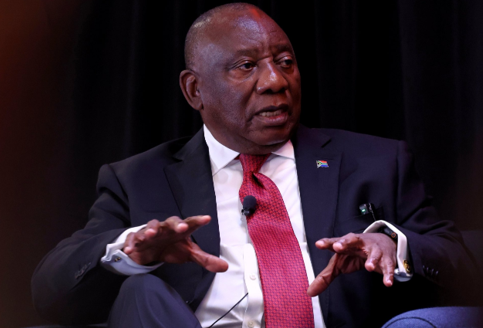
Silicon Valley, California - President Cyril Ramaphosa has emphasised the importance of safeguarding South Africa’s data sovereignty and strengthening cybersecurity as the country deepens its engagement with global technology companies to advance artificial intelligence (AI).
During a fireside chat with executives of global cybersecurity company Palo Alto Networks in Silicon Valley on Friday, the President said South Africa wants to benefit from international expertise, while building its own capabilities to develop, adapt and use AI in ways that serve its national interests.
The discussion, which included Palo Alto Networks Executive Vice President and General Counsel Bruce Byrd and Chief Product and Technology Officer Lee Klarich, explored the opportunities presented by AI, the security considerations accompanying its adoption and the importance of partnerships in building local expertise.
President Ramaphosa said AI represents a technological revolution that will change how people live and work, as well as how governments interact with citizens and grow their economies.
He identified opportunities for South Africa to use the technology to strengthen the capacity of the State, improve productivity across economic sectors, attract investment, support start-ups and entrepreneurs, and create opportunities for young people.
The President also highlighted the importance of partnerships that facilitate knowledge transfer and skills development, saying South African innovators and researchers should be able to learn from global technology leaders, while contributing to the development of new technologies.
He said the country wants to establish mutually beneficial partnerships, where South Africa is recognised as a contributor, instead of merely a consumer of technology.
“We were left behind in the industrial revolution, and the digital revolution. But this is one revolution that we want to be part of, so that we are not only seen as consumers, but we should also be seen as partners."
Protecting data and building cybersecurity capacity
On data sovereignty, President Ramaphosa said South Africa wants to maintain control over its information, while benefiting from the capabilities developed by international technology companies. He said the country needs to develop its own expertise by exposing young people, researchers and academics to the mechanisms and workings of AI technologies.
“We are a developing economy and therefore, whatever capabilities we can glean from the rest of the world, [should] be good for our country.
"We want AI that is going to protect working people so that even as certain functions are replaced, we are able to reskill our people and they [can] find occupations and jobs in other areas."
The President said AI should enhance human capability and operate with appropriate safeguards and human intervention.
Meanwhile, Klarich said organisations need to ensure that the security measures accompanying AI adoption keep pace with the technology itself. He explained that previous technological revolutions had often seen the adoption of new information technology precede the development of corresponding security measures, sometimes by several years.
“I think there's an opportunity with AI to do that differently -- to think about the technology revolution and the corresponding security revolution,” Klarich said.
He said this will require partnerships, shared learning and investment, adding that no single organisation or company has all the answers needed to ensure the safe adoption of AI.
He said insights gained from protecting organisations in different parts of the world could help strengthen cybersecurity for other customers, provided that their data remain under their control.
He further explained that advances in training open-weight AI models could allow models to operate within a country's borders and be adapted to specific requirements.
“We can help train models that run within your borders for you, and in some cases, even specialised for needs,” Byrd said.
President Ramaphosa welcomed the opportunity to learn from Palo Alto Networks, particularly its expertise in cybersecurity, and called for the company to make its knowledge and capabilities available to South African researchers, innovators and young people.
He said local talent should not only acquire knowledge but also use it to improve existing technologies and train models to respond to South Africa's needs.
“We want to absorb the capability but also be able to own it and utilise it for our purposes."
The President said the country has considerable talent that could contribute to the development of AI and help direct technologies towards local priorities.
He reiterated that South Africa wants to build partnerships that deliver mutual benefits, while enabling the country to develop its own capabilities.
He said the visit to Silicon Valley provided the South African delegation with an opportunity to gain insight into technologies that are transforming the world and to explore how South Africa can participate in shaping their development.
“We don't want to be left behind. We want to be part of it,” the President said. – SAnews.gov.za


