


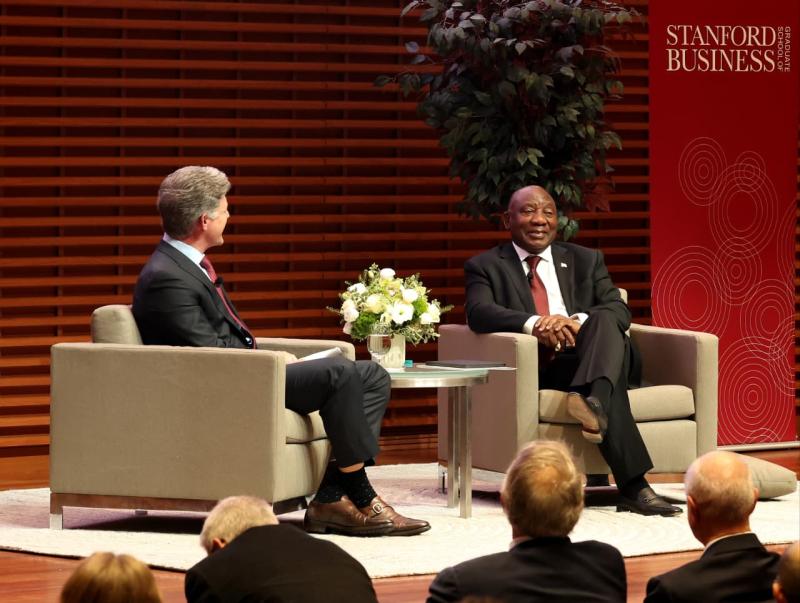
President Cyril Ramaphosa has invited investors from Silicon Valley to explore opportunities in South Africa, highlighting ongoing economic reforms, improved energy generation and a R1 trillion infrastructure investment programme as key drivers of the country's growth ambitions.
The President made the call during a fireside chat at Stanford University in California, where he outlined South Africa's efforts to reposition its economy, attract investment and create an environment conducive to business growth.
Addressing academics, students and members of the university community, President Ramaphosa said South Africa was working towards achieving economic growth of 3%, which he described as an ambition shared by government, the private sector and citizens.
“And in fact, it is the ambition of our people because out of growth we will be able to create more jobs. And so, we have partnered and continue to partner with the private sector to foster the reforms and to speed them up, to speed up the reforms that we have embarked upon,” he said.
The President said the country's reform programme was beginning to yield results, particularly in the electricity sector, while government was also working to improve the performance of ports, harbours and the broader logistics network.
He said these reforms were important in creating a foundation for sustainable economic growth and attracting new investment.
“We are also looking at infrastructure growth. We have budgeted 1 trillion rand infrastructure investment, for the very first time in South Africa that we're going to have 1 trillion rand to be invested in three years to ramp up infrastructure, because we see infrastructure as the flywheel that will generate more growth,” he said.
President Ramaphosa said the infrastructure investment programme would support economic activity, improve the country's productive capacity and create an enabling environment for businesses.
He also stressed the importance of strengthening the capacity of the State and improving the relationship between government and the private sector.
“But at the same time, obviously, we want to have a capable state that will drive that growth. We want to work together with a private sector that will cooperate with government, but we also need to get rid of the bureaucracy that tends to hold back the execution of some of our ambitions,” he said.
The President said South Africa was actively working to improve its investment climate and open the economy to investors from across the world.
“We are creating an environment in which investment can come into the country, where we can attract investors from all over the world. And now, with our visit here, we would like investors from Silicon Valley to come in and invest in South Africa.
“Because we are repositioning our country, we're making South Africa much more investor-friendly, and we're opening the doors of South Africa for investment,” he said.
President Ramaphosa said the country's growth ambitions were also dependent on developing a skilled workforce capable of supporting new investments and emerging industries.
He said this was one of the reasons the government had included a significant number of young people in the Silicon Valley mission: to provide them with exposure to global technology developments and opportunities to learn from leading institutions and businesses.
“They are soon going to get into various skilled jobs and run their own and establish their own companies. And they are the future. So, we're focusing our attention on skills as well to improve the skill base of South Africa,” he said.
The President said government was also placing greater emphasis on early childhood development and improving the quality of education to ensure that young people were equipped for a changing economy.
He said South Africa needed to start building technological skills from an early age.
“We are now starting at that level to undo the damage that was done by apartheid, because two things that apartheid did were the dispossession of our people's assets, as well as Bantu education, or bad education.
“We're reforming our education and starting the education at a very young age so that children at four years old should be able to code, they should be able to be proficient with technology and now of late with artificial intelligence as well, because that will improve their skill base and that will enable them to be important players in the economic development of our country,” he said.
During the discussion, the President also highlighted South Africa's improved electricity generation capacity as an important factor in attracting investment, particularly in energy-intensive industries such as data centres.
He said the country's energy reforms had been driven by collaboration between government, business, labour and other stakeholders.
“We were able to make our power generation much more efficient. And we're now in the process of reforming our electricity architecture and ensuring that generation, transmission and distribution all work extremely well to generate power in our country,” he said.
He added that international technology companies were already establishing data centres in South Africa, while local companies were also investing in the sector.
However, he said the country wanted to attract investment that would support broader economic participation and enable South Africans to benefit from the full value chain of emerging technologies.
The President also stressed the importance of strengthening the country's constitutional and institutional foundations to give investors certainty.
He pointed to the independence of the judiciary, Parliament, the central bank and other democratic institutions as important pillars supporting South Africa's stability.
He said government was also focusing on professionalising the public service to ensure that it had the necessary skills to implement policies and deliver services.
Responding to a question about South Africa's longer-term economic prospects, President Ramaphosa painted a picture of a country that had overcome the historical constraints of colonialism and apartheid, achieved stronger economic growth and developed a highly skilled population.
He said his vision was for South Africa to become an economy that was growing at between 5% and 6%, with low poverty and inequality, high employment and a strong technological base.
“And where South Africa has an economy that will be growing, let's say 5% or 6% or so, where the new technologies of the world are well appropriated in South Africa and where South Africa is also generating new technologies,” he said.
The President said he wanted future generations to inherit a country that offered quality education, meaningful employment, safety and opportunities to participate in a modern economy.
He said the Presidential visit to Silicon Valley was among the initiatives intended to help reposition South Africa and accelerate its development.
“And one of those is just being able to come here. Coming here is one of those, what I call enablers that have brought us here to be able to delve into what artificial intelligence is all about, so that it can contribute to the growth of our country,” he said.
President Ramaphosa said South Africa was determined to build on the opportunities emerging from the visit by pursuing investment, partnerships and practical initiatives that would contribute to the country's economic development. – SAnews.gov.za


