


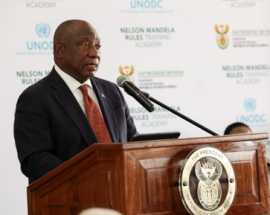
Exactly 36 years after President Nelson Mandela walked out of prison and into the pages of history, President Cyril Ramaphosa returned to the very grounds where that decisive moment unfolded, reaffirming South Africa’s commitment to justice anchored in human dignity.
Before the formalities began on Wednesday morning at Drakenstein Correctional Facility -- where President Cyril Ramaphosa officially opened the Nelson Mandela Rules Training Academy -- the First Citizen made a deeply personal pilgrimage to the Madiba House, the residence that housed Nelson Mandela during the final years of his imprisonment.
It was here, on the grounds formerly known as Victor Verster Prison, that the world waited with bated breath for a man whose freedom would signal the dawn of democracy.
Standing within the same gates where the eyes of the world once converged, President Ramaphosa reflected on the anticipation, fear and hope that defined that moment.
“Leading up to this release, we were all in a moment of great excitement that our struggle was reaching a point of inflection, and with the release of the prisoners, we knew that a new era was opening up, a new opportunity was coming about, which would enable us to launch even much more positive and powerful phases of the struggle,” the President said.
Later in the morning, the President officially opened the Nelson Mandela Rules Training Academy — the first of its kind on the African continent. He described the moment as both deeply personal and nationally significant.
“Thirty-six years ago - almost to the day - the eyes of the world were fixed on the gates just beyond where we stand now. They were waiting for the moment one man would walk out of the gates of history, and into legend.
“At around four-fifteen pm local time, Nelson Rolihlahla Mandela, with Winnie Madikizela-Mandela beside him, walked out of the gates into the massive crowd that had gathered to greet him,” the President said during his speech.
For President Ramaphosa, the memory is not distant history -- it is lived experience. He spoke candidly of both inspiration and fear.
“This is a historic moment. It's very moving for me, having been here to watch history unfolding. It was watching a legend move out of this place that had incarcerated him and kept him, and like a bird, Madiba could not be caged. He had to fly out,” he said.
He also shared the lesser-known anxiety that accompanied that moment of triumph -- the fear for Mandela’s safety.
“The only trepidation that I had, together with others, was his safety, because we knew that we didn't want him to be under the safety protection of the apartheid regime. We feared that they would kill him… and so we wanted to have a separation with regards to the safety of this man, who was going to lead the nation,” the President said.
In a remarkable recollection, the President revealed that he and Reverend Mkhatshwa even travelled to Sweden for training on how to protect President Mandela - a reflection of the uncertainty and responsibility that rested on young shoulders at the time.
“For us, that was a moment of great fear… But ahead of that, Reverend Mkhatshwa and I had gone to Sweden to be trained as people who could protect Nelson Mandela… They helped to prepare us how we would look after him,” the President said while laughing.
For the President, that day remains profoundly personal.
“To have been there beside the father of our nation as he took his first steps as a free man, remains one of the greatest honours of my life. Few moments have marked me more than being witness - at close quarters, to the day that lit the path toward the birth of a new South Africa.”
Now, three and a half decades later, the President said Drakenstein once again stands at the centre of transformation.
“Today, the Drakenstein Correctional Facility once again stands at the threshold of a new chapter in our country’s history,” he said.
The Nelson Mandela Rules Training Academy, he said, is more than brick and mortar.
“This is not merely a building, but a story. You are welcomed by striking artwork depicting Madiba’s art created by offenders themselves. This is not incidental. It is deeply symbolic. It reflects the very essence of rehabilitation. It is about unlocking human potential, creativity and self-worth,” the President said.
He said it is a story rooted in dignity, in second chances, and in the belief that justice must be anchored in humanity. Having endured 27 years in prison, Madiba’s life embodied the principle that even those behind bars retain their inherent dignity.
“Madiba believed that offenders are deserving of dignity, respect and humane treatment, and that justice is not measured by how harshly we punish, but by how faithfully we uphold human dignity, even in the most difficult circumstances,” he said.
The President confronted the national frustration over crime, acknowledging the temptation toward harsh retribution.
“We cannot talk about overcoming crime in South Africa without having a frank, honest conversation about the rehabilitation of offenders, their re-integration into society, and prevention of re-offending.
“Our people are fed up with crime, and at most times are inclined to the ‘lock the door and throw away the key’ mentality when it comes to offenders. Yet, this will not serve us in the long term as a country,” the President said.
He painted a sobering picture of the cycle of re-offending and the stigma ex-offenders face, including unemployment, untreated mental health challenges, broken trust, gang pressures and social isolation.
“Facing social stigma, an unwelcoming environment and social isolation, far too many return to a life of crime.”
The Academy, President Ramaphosa declared, seeks to change that trajectory.
“The Nelson Mandela Rules Training Academy is determined to break this cycle,” he said.
As sunlight filtered across the grounds where Madiba once walked to freedom, the symbolism was unmistakable. From incarceration to liberation. From punishment to rehabilitation. From history to living legacy.
“This facility symbolises the humanisation of corrections, the elevation of dignity, and the global pursuit of justice rooted in humanity,” he said.
In conclusion, the President paid tribute to the men and women of the Department of Correctional Services, who perform one of the most demanding and often unrecognised duties in the public service.
“Your commitment affirms that even in the most difficult circumstances, our correctional system remains anchored in humanity, professionalism and service to the nation.
“May this academy stand as a living tribute to Nelson Mandela’s legacy. May it shape generations of correctional practitioners committed to dignity and reform,” he said. – SAnews.gov.za


