


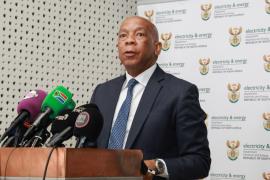
Electricity and Energy Minister, Dr Kgosientsho Ramokgopa, has tasked Eskom’s board with driving down electricity costs, improving reliability and securing the utility’s long-term future, as Dr Mteto Nyati continues as Chairperson.
Nyati’s continued leadership provides stability as Eskom moves beyond the immediate task of restoring generation performance towards securing its role in South Africa’s evolving electricity market.
Speaking at a media briefing in Pretoria on Friday, Ramokgopa emphasised Eskom’s critical role in supporting investment and jobs while easing pressure on households through a reliable and affordable electricity supply.
“Eskom has an indispensable role in that work. The shareholder expects its Board to turn the gains of the recovery programme into a sustainable future for the utility and better service for the people who depend on it,” the Minister said.
He outlined the shareholder’s expectations for Eskom 2.0, saying the utility must plan for new generation capacity, expand the grid, strengthen customer relationships and adapt to the entry of new generators and traders.
The board is expected to develop a single roadmap for Eskom covering the next three, five and 10 years.
“It must define the utility’s public obligations, future generation mix, commercial position and the investment required to sustain them. Eskom must be able to fulfil its mandate without relying on repeated fiscal support or sustained double-digit tariff increases as a business model,” the Minister said.
In line with the Integrated Resource Plan 2025, Eskom must undertake the technical and financial work needed to inform board decisions on the future of its generation fleet.
This includes reducing emissions from existing coal-fired power stations, assessing coal-abatement technologies, repurposing and repowering power-station sites, and defining Eskom’s strategic role in gas and nuclear energy.
“Eskom Green must turn its approved strategy into a credible pipeline of projects. Its planned engagement with potential partners on approximately 2 GW of renewable capacity is an early step in that work,” Ramokgopa said.
He added that expanding the transmission network was essential to connect new generation capacity and meet growing industrial demand.
“The shareholder expects Eskom and the National Transmission Company South Africa to advance a deliverable grid programme, including through Independent Transmission Projects. The scale of this investment must also support South African manufacturers, suppliers and skills development.”
Eskom’s growth strategy must also extend across Southern Africa, with regional demand and supply informing opportunities for electricity trade and cross-border interconnectors.
“Viable projects need to be developed with regional partners and potential funders, including the Development Bank of Southern Africa (DBSA), the Industrial Development Corporation (IDC) and the African Development Bank,” Ramokgopa said.
The Minister also called for a stronger commercial and customer-focused strategy.
“Mining and industry remain important sources of demand. Data centres require a deliberate approach to reliable supply, suitable locations, network capacity and long-term contracts.”
“Customer care must be central to Eskom’s plans to retain and attract customers through dependable service, accurate billing and the timely resolution of complaints. Municipal debt continues to place electricity supply and network investment under pressure,” Ramokgopa said.
The Department of Electricity and Energy will work with National Treasury, the Department of Cooperative Governance and Traditional Affairs (CoGTA), and the South African Local Government Association (SALGA) to strengthen payment discipline and improve arrangements for sustainable electricity supply.
“Free Basic Electricity must reach eligible households. Smart metering can improve customer service while strengthening revenue collection and the management of distribution networks,” the Minister said.
The shareholder expects the board to reduce system losses and revenue leakage, secure better value from procurement, maintenance and project delivery, and continue strengthening financial controls.
The Minister said Eskom’s objective should be to obtain an unqualified audit opinion with no material findings.
The utility must also expand its use of artificial intelligence, initially to address technical losses, forecasting and grid management, and progressively across its broader operations. – SAnews.gov.za


