


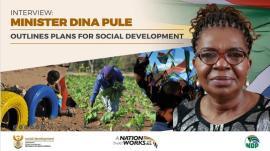
Newly appointed Minister of Social Development Dina Pule has assured the millions of vulnerable South Africans who are dependent on social grants that their monthly payments will continue uninterrupted.
In an exclusive interview with the Government Communication and Information System (GCIS) on Tuesday, Pule outlined plans to strengthen the department's systems, tackle substance abuse and intensify efforts to protect children from trafficking and exploitation.
She stressed that grant beneficiaries should not be concerned about the transition from the South African Social Security Agency (SASSA) gold card to the Postbank black card, saying the change will not affect grant payments.
"I want to assure the people of South Africa, especially South African Social Security Agency beneficiaries, that they must not worry. They will receive their grants on time. All they need to do is change from the gold card to the black card, but this will never affect their grants," Pule said.
She said the Department of Social Development, SASSA, Postbank and the Department of Communications and Digital Technologies were working together to address operational matters relating to the migration process.
According to Pule, grant payments will continue to be deposited directly into beneficiaries' chosen bank accounts, including Postbank and commercial banks.
"Beneficiaries should remain calm. Their grants will continue to be paid into their accounts every month, and they can withdraw their money using their bank cards at participating outlets," she said.
Pule said the new payment system would reduce logistical challenges previously associated with transporting cash to payment points, making the grant payment process more efficient and reliable.
She added that government is also introducing biometric verification measures to strengthen the integrity of the social grant payment system.
Strengthening the department
Looking ahead to her first 100 days in office, Pule said her focus would be on implementing the department's approved strategic plan, strengthening internal systems and ensuring that the right people are appointed to key positions.
She noted that the department manages an annual budget of about R300 billion and provides social assistance to approximately 28 million South Africans through various grant programmes.
"The department exists to improve the lives of people who are in need. Our responsibility is to ensure that we improve the lives of vulnerable South Africans and provide them with the support they require," she said.
Drawing on her previous experience in provincial and national government, Pule said integrity, accountability, teamwork and open communication would underpin her leadership approach.
"We are dealing with people, public funds and vulnerable communities. That requires integrity, accountability and mutual respect. Communication is equally important because it allows us to respond to the concerns of the public and resolve challenges as quickly as possible," she said.
Tackling substance abuse
Substance abuse is one of the department's major priorities, particularly among young people.
The Minister said the department co-chairs the Inter-Ministerial Committee on Substance Abuse together with the Department of Women, Youth and Persons with Disabilities, working alongside departments, including Health, Justice and Constitutional Development, Police, and Trade, Industry and Competition.
The department, she said, continues to roll out prevention programmes targeting young people, including skills development initiatives and awareness campaigns aimed at discouraging substance abuse.
Pule said specialised programmes are also available for pregnant women affected by substance abuse, while rehabilitation centres across the provinces continue to provide treatment, counselling and reintegration support.
She added that survivors of gender-based violence are supported through facilities that provide protection and rehabilitation services.
Protecting children from trafficking
Protecting children from trafficking, unlawful removal and other forms of exploitation also remain a key priority for the department, Pule said.
She explained that the department works closely with the Border Management Authority (BMA) to identify children travelling unaccompanied or under suspicious circumstances.
"When children are travelling without their parents or guardians, investigations are immediately initiated to establish the circumstances. Where necessary, social workers are deployed to intervene and ensure that children are protected," she said.
Pule said the department has a dedicated directorate responsible for child protection, with social workers conducting investigations and intervening whenever children are identified as being at risk of trafficking or exploitation.
She reaffirmed the department's commitment to strengthening social protection programmes and ensuring that the country's most vulnerable citizens continue to receive the support and protection they need. – SAnews.gov.za


