


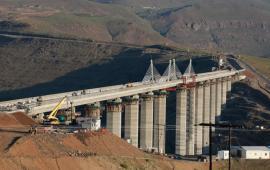
South Africa and the Kingdom of Lesotho will next week officially unveil the completed Senqu Bridge, marking a major milestone in Phase II of the Lesotho Highlands Water Project.
In a significant boost for regional integration and water security, the bridge will be declared ready for use by motorists on 22 April 2026 in Mokhotlong District, Lesotho.
Constructed at a cost of approximately R2.4 billion, the Senqu Bridge is the largest of three major bridges being developed as part of Phase II, alongside the Mabunyane and Khubelu bridges.
These crossings are designed to ensure continued access across the Polihali Reservoir once water levels rise following the dam’s completion.
Measuring about 825 metres in length and standing roughly 90 metres high, the Senqu Bridge will provide a vital transport link across the reservoir, maintaining connectivity to the national road network via the A1 route, which links Mokhotlong to Maseru.
According to the Department of Water and Sanitation, the bridge is a “legacy infrastructure asset” that will ensure uninterrupted access to key areas such as Mokhotlong and surrounding communities, even after existing routes are submerged by the Polihali Dam.
Strengthening a flagship regional project
The Senqu Bridge forms part of the broader LHWP, a multi-phased, treaty-based partnership between South Africa and Lesotho established on 24 October 1986 to address water security, energy generation and socio-economic development.
The project harnesses the Orange–Senqu River system through a network of dams and transfer tunnels, supplying water to South Africa’s Integrated Vaal River System, which supports the economic hub of Gauteng.
At the same time, Lesotho benefits through hydropower generation, infrastructure development and long-term economic opportunities.
Phase II of the project is currently under construction and includes the Polihali Dam, a concrete-faced rockfill structure approximately 165 metres high, as well as a 38-kilometre transfer tunnel that will connect the Polihali and Katse reservoirs.
Once completed, this phase will increase water supply capacity from 780 million cubic metres per annum to 1 270 million cubic metres per annum, significantly strengthening long-term water security for South Africa.
Engineering achievement and economic impact
Beyond its strategic importance, the Senqu Bridge represents a major engineering accomplishment in one of Southern Africa’s most challenging terrains.
It is the first extradosed bridge in Lesotho, combining cable-stayed and prestressed girder design, and was constructed using an incremental launching method to improve safety and reduce environmental disruption.
The project has also delivered tangible economic benefits. It created approximately 250 000 person-days of employment, with a peak workforce of around 1 200 workers, the majority of whom were Basotho.
In addition, procurement processes were structured to promote inclusivity, with significant expenditure directed towards local enterprises in both countries, including South African black-owned firms.
Phase I: Laying the foundation
Phase I of the LHWP, completed in 2003, laid the foundation for the current expansion. It comprised two sub-phases and included the construction of major infrastructure such as the Katse and Mohale dams, as well as the Muela Hydropower Station.
The Katse Dam, completed in 1997, is one of the highest dams in Africa and serves as the main storage reservoir of the project. It is connected to the Mohale Dam through a transfer tunnel, forming an integrated system that delivers water to South Africa via an extensive network of tunnels.
Phase I currently delivers approximately 780 million cubic metres of water annually to South Africa, significantly enhancing water security for Gauteng and surrounding areas, while enabling Lesotho to generate hydropower and earn revenue through water royalties.
Phase II: Expanding capacity and impact
Phase II, which commenced in 2022 following earlier delays, builds on this foundation and is estimated to cost around R42 billion.
Key components include the construction of the Polihali Dam, a 165-metre-high concrete-faced rockfill dam, and the 38-kilometre transfer tunnel linking Polihali to Katse. Additional infrastructure includes bridges, feeder roads, accommodation facilities, power lines and telecommunications.
Once completed, Phase II will increase water transfer to South Africa by an additional 490 million cubic metres per year, raising total supply to approximately 1 270 million cubic metres annually into the Integrated Vaal River System.
Progress on major components is advancing steadily, with the Polihali Dam over 50% complete and tunnelling work nearing the halfway mark.
Build-up event to spotlight tunnel construction
Ahead of the official launch, Water and Sanitation Minister Pemmy Majodina and Lesotho’s Minister of Natural Resources Mohlomi Moleko will on 20 April unveil the Tunnel Boring Machine (TBM) at the Polihali construction site.
The TBM is a critical piece of equipment that will be used to drill the 38-kilometre tunnel connecting the Polihali and Katse reservoirs, a central feature of Phase II aimed at increasing water transfer capacity to South Africa.
Advancing regional integration and development
The LHWP continues to stand as a flagship example of regional cooperation, demonstrating how shared natural resources can be managed through rules-based collaboration for mutual benefit.
Through joint governance structures and coordinated implementation, the project reflects a high level of trust and interdependence between South Africa and Lesotho.
As Phase II progresses, infrastructure such as the Senqu Bridge is expected to play a critical role not only in supporting construction and connectivity, but also in enabling long-term development outcomes, including improved mobility, access to services and expanded economic opportunities.
The launch of the bridge signals continued progress in one of Africa’s most ambitious water infrastructure projects, reinforcing the role of regional partnerships in addressing shared development challenges. – SAnews.gov.za


