


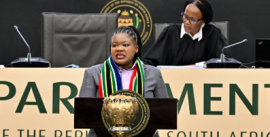
As the country commemorates Youth Month in June government continues to work towards improving young people’s access to the labour market and economy, Deputy Minister in the Presidency Nonceba Mhlauli said.
“South Africans are …asking for work that can be seen, felt and trusted. Essentially, South Africans want a government that works for all, especially its young people who constitute 59% of the country’s total population,” Mhlauli said on Tuesday.
The Deputy Minister was speaking in support of the Presidency Budget Vote tabled by President Cyril Ramaphosa in the National Assembly.
“The youth of this country have for the past 50 years since June 16 1976, and beyond; demonstrated that they do not lack ideas, talent, and courage to stand up for their future. What they lack is access,” she said.
Initiatives like the Presidential Youth Employment Intervention (PYEI) which the President launched in 2020, are actively expanding that door to access with the recently released quarter 3 results for 2025/26 having demonstrated real, quantifiable momentum in the drive to transition young people from learning to earning.
In the third quarter alone, the PYEI facilitated 294,530 new earning opportunities while more than 5.77 million young people had registered on the SA Youth platform.
READ | Presidential Youth Employment Intervention continues to produce results
“Since its inception, the PYEI has facilitated access to more than 2.36 million earning opportunities,” she said adding that over 70% of the opportunities accessed through SA Youth have been taken up by young women, helping close historical gender gaps.
Mhlauli said the success of the PYEI reflects government's commitment to tackling youth unemployment through targeted intervention and innovation.
“At a time when youth unemployment remains one of South Africa's greatest challenges, the programme stands as evidence that government action can make a meaningful difference in the lives of young people,” she explained.
The Jobs Boost Outcomes Fund exceeded its targets this quarter, enrolling over 9,170 young people and successfully placing more than 7,200 into employment.
“This is funding real outcomes,” said the Deputy Minister.
Meanwhile, the Revitalised National Youth Service continues its rapid expansion, having placed 132,784 young people in paid service opportunities to date, with additional 100 000 opportunities currently available on SA Youth.Mobi.
She called on youth between the ages of 18 and 35 to participate in the programme that is focused on community service, skills development and gain meaningful work experience.
In addition, the Youth Employment Service (YES), a private sector led initiative in partnership with the Presidency, has created over 228 000 youth jobs with an absorption rate of 60% into fulltime employment post the programme.
The Deputy Minister added that 17% of YES alumni have started their own business with the support of the programme across sectors.
“Through sustained investment in youth employment and empowerment programmes, partnerships with the private sector, and the allocation of public resources to create opportunities for young people, this government has enabled hundreds of thousands of youth to gain work experience, skills, and pathways into the labour market.”
She said the country has made progress over the years as stated in Statistics South Africa’s General Household Survey.
“South Africa’s total life expectancy at birth increased from 55.2% in 2002 to nearly 67% in 2025,” she said adding that 84% of households live in formal dwellings and with more than half of these households owning their homes.
She added that 94.9% of South Africa’s households have access to electricity and that 87.4% of South African households have access to piped water with 8.1 million more households having gained piped water since 2002.
On education, 96.6% of school participation is achieved by age 15 and 52.9% of South African adults now have at least Grade 12, with an enrolment of 1.9 million students in public institutions of higher learning as of 2024. -SAnews.gov.za


