


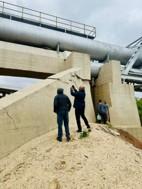
Western Cape Local Government, Environmental Affairs and Development Planning MEC Anton Bredell, together with stakeholders, has conducted an oversight visit to the flood damaged Krans Bridge Siphon near Klawer in the province.
Bredell, accompanied by representatives from the Department of Water and Sanitation, the Lower Olifants River Water User Association, local government and technical experts, visited the site to assess the extent of the damage, its implications for downstream water users and the interventions required to restore the system.
The Krans Bridge Siphon was significantly damaged during severe floods in May 2026, when floodwaters and debris shifted the steel pipeline from its supporting structures.
The siphon forms part of the regional bulk water supply network serving communities including Vredendal, Klawer, Vanrhynsdorp, Lutzville and Koekenaap, as well as agricultural and industrial users across the Lower Olifants region.
Bredell emphasised the importance of restoring the infrastructure to maintain water security for communities and sustaining economic activity in the region.
“This infrastructure is of strategic importance to the communities, agricultural sector and industries that depend on a secure and reliable water supply.
“The damage caused by the floods highlights the growing pressure that severe weather events place on critical infrastructure,” the MEC said.
He noted that the provincial Department of Local Government will coordinate efforts among the relevant stakeholders to support the restoration process.
“The Department of Local Government will play a coordinating role to ensure alignment and cooperation between national, provincial and local institutions involved in this process.
“While the technical assessments and implementation responsibilities rest with the relevant authorities and infrastructure owners, our role will be to facilitate collaboration, remove obstacles where possible and ensure that all stakeholders remain focused on restoring this critical asset as quickly as possible,” the MEC said.
Discussions during the site visit focused on engineering assessments needed to determine the most appropriate repair and rehabilitation options.
Stakeholders also considered the potential impact of the damaged infrastructure on water security, agricultural and industrial activity, as well as the need to strengthen the resilience of critical infrastructure against future extreme weather events.
The coordinated response is expected to inform the rehabilitation approach and ensure that the interests of affected communities and water users are taken into account as restoration efforts progress. – SAnews.gov.za


