


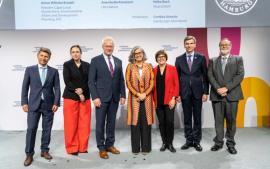
Water security and food production were some of the issues that Western Cape MEC for Local Government, Environmental Affairs, and Development Planning, Anton Bredell spoke to at the Hamburg Sustainability Conference in Germany.
This as the MEC participated in a panel discussion focused on food security and water management in the context of global climate change.
Bredell stated that water security and food production systems are interconnected in the Western Cape, a water-scarce region affected by climate change, which is making the province hotter and drier, contributing to more intense wildfires, droughts, and floods.
“We also have the added complexity of poverty, inequality, and a fast-growing population. These socio-economic dynamics make it very challenging to plan, budget, and construct the water and wastewater infrastructure we need to provide future water security in our region,” he said.
Held from 2-3 June 2025, the Hamburg Sustainability Conference brought together leading actors from politics, business, science, and civil society to jointly shape actionable pathways toward achieving the United Nations Sustainable Development Goals (SDGs).
The MEC stated that the average daily water consumption per person in South Africa is 216 litres, higher than the international average of 173 litres.
The Western Cape manages to generate revenue from 70.4% of water supplied to consumers, meaning that 30% of water is either lost in the system or it was delivered to a consumer without generating any revenue.
Meanwhile, a portion of the non-revenue water is supplied free of charge to poor and vulnerable residents.
The provincial government said this is part of a dignity basket, which also includes a set amount of free electricity and other basic municipal services.
“Our research on what constitutes water dignity found that the current 6 kilolitres a month per household, as prescribed in South African legislation, is not sufficient, and it should be much higher, at 15 kilolitres per household.
“These findings raise serious questions on our approach to water management in South Africa and especially in our local governments, where ratepayers are being pushed to pay more for services to also help subsidise the dignity basket to an increasing number of indigent households.”
The MEC stated that there are only limited opportunities for additional bulk water storage in the Western Cape.
He believes that this will help ensure future water security will rely on improved supply and demand management, alternative sources such as groundwater, water reuse, and desalination.
The Western Cape Government is budgeting R32 million for the 2025/26 financial year to support municipalities with water and wastewater infrastructure projects. – SAnews.gov.za


