


The University of KwaZulu-Natal’s (UKZN) School of Engineering has upgraded its computer laboratory, following a R2.2 million investment by Aberdare Cables to improve digital learning and strengthen engineering skills development.
The lab can accommodate 163 students.
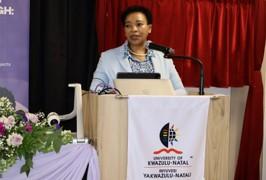
Deputy Minister of Higher Education and Training, Dr Nomusa Dube-Ncube, officially launched the AberTech LAN facility on Wednesday, an investment which will help prepare students for the demands of a rapidly changing technological and industrial environment.
The upgraded facility, which previously accommodated 80 students, features 175 new network access points, modern workstations, new projection systems, improved lighting and a collaborative learning environment.
Dube-Ncube welcomed the investment as an example of how partnerships between government, higher education institutions and industry can improve the quality of education and ensure graduates acquire relevant workplace skills.
“A student who learns on outdated machines risks graduating with outdated skills. A student who models, simulates, codes and designs on current systems enters the workplace ready to contribute from the first day,” Dube-Ncube said.
She encouraged Aberdare Cables and UKZN to expand their partnership beyond infrastructure and bursaries to include Work Integrated Learning opportunities, internships and workplace placements.
The Deputy Minister underscored the importance of industry investment in engineering education to develop the skills needed to support South Africa’s economic growth, particularly in the energy sector, including electricity grids, renewable energy projects and transmission networks.
Dube-Ncube noted the partnership built on Aberdare Cables’ existing support for engineering and information and communications technology students through bursaries.
She said such collaborations are aligned with government’s commitment to expanding access to quality post-school education and training (PSET) and making institutions more responsive to the economy.
In the 2026 State of the Nation Address, President Cyril Ramaphosa placed the Skills Revolution at the centre of the country’s development agenda under the theme: “A Nation that Works for All.”
The President also directed the Ministers of Finance and Higher Education and Training to develop a proposal for more universities and Technical and Vocational Education and Training (TVET) colleges with specialised areas of focus.
“Government cannot do this alone. Partnerships like this one are how those commitments become real,” Dube-Ncube said.
She added that modern teaching and learning facilities are increasingly important as artificial intelligence and other technological advances transform the workplace.
Students were also called to protect the facility against vandalism and theft, while the university has been urged to establish a clear maintenance plan and budget for software licences and the regular renewal of equipment.
“Every rand invested, whether public or private, must deliver lasting value.”
Call for peaceful resolution of disputes
Addressing student conduct, Dube-Ncube called for peaceful resolution of disputes, following tensions surrounding the university’s Student Representative Council elections, including an incident at the Westville Campus in which staff members were injured.
While acknowledging that student elections are an important school of democracy, and disagreement as part of democracy, she said disputes must be settled through university rules, appeal processes, dialogue and the law, rather that violence, intimidation or disruption of other students’ learning.
“Violence against the staff who keep our campuses safe is unacceptable,” she said, calling on all student formations to protect the university’s people, reputation and facilities.
Dube-Ncube further urged students to promote respect and equality, highlighting the need to address gender-based violence and femicide (GBVF) in the PSET system.
She called on young men, to champion equality and encouraged students experiencing substance abuse, or other challenges to seek support from campus services and Higher Health.
The Deputy Minister noted the facility also supported efforts to develop engineering solutions to climate change, including resilient infrastructure, efficient energy systems and clean technologies.
She linked the investment to the United Nations Sustainable Development Goals (SDGs) on quality education, gender equality, industry, innovation and infrastructure, and climate action. – SAnews.gov.za


