


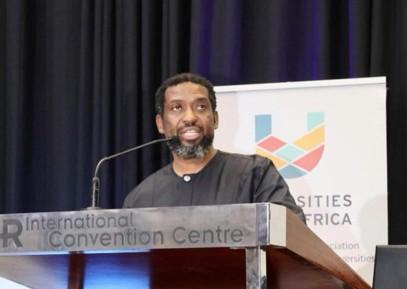
Higher Education and Training Minister Buti Manamela has called on South African universities to strengthen their financial sustainability and governance, while ensuring that they remain focused on their public purpose.
Addressing the 4th Universities South Africa (USAf) Higher Education Conference at the Council for Scientific and Industrial Research (CSIR) Convention Centre on Wednesday, Manamela said universities cannot fulfil their purpose if they are financially unstable, warning that financial sustainability must not come at the expense of their responsibility to society.
“A university that cannot pay its bills cannot fulfil its purpose, but a university that balances its books, while losing its public purpose, has also failed,” Manamela said.
Held under the theme: “Co-creating a Resilient Future”, the conference brought together university leaders, academics, researchers, professional staff, students, labour representatives and international guests.
Manamela said the future of higher education must be considered through three interconnected issues: how universities are financed, how they are governed, and the kind of knowledge and human capability they develop in a rapidly changing world.
“Public trust connects all three. It depends on the choices we make about resources, power and knowledge.”
On university funding, the Minister stressed the need to distinguish between student and institutional financing.
“They are connected but they are not interchangeable. Getting NSFAS [National Student Financial Aid Scheme] to work reliably is essential. It does not, on its own, repair a laboratory, renew a library, support a research programme or reverse years of deferred maintenance.
“A funded student needs a functioning institution. A functioning institution needs students who can afford to learn. Our financing debate must hold both obligations together,” the Minister said.
He also warned universities against waste, saying every rand lost through poor procurement, unmanaged projects or decisions taken for private advantage reduces the resources available for teaching and research.
“We need an honest account of the full cost of student success. We need to know which costs are necessary for academic quality, which activities can be shared, and which arrangements persist because nobody has been willing to change them.
"The measure of success cannot be enrolment alone. We should ask whether students learn, complete their studies and acquire the capacity to contribute to society and build livelihoods,” he explained.
On governance, Manamela reaffirmed the importance of university autonomy and academic freedom, saying universities must be able to produce evidence and arguments that government may find inconvenient.
He said councils, senates, executives, students and staff each have distinct responsibilities that need clear boundaries and effective working relationships.
“When councils drift into daily management, executives evade oversight, or institutional disputes become contests over access to resources, the university loses time, money and credibility.”
Manamela also called for stronger accountability, noting this should extend beyond the submission of documents, to whether decisions are lawful, conflicts of interest are managed, concerns are heard, and consequences follow misconduct.
Manamela further called for closer collaboration between government, universities, industry, communities, students and labour to build a resilient higher education system.
This can include exploring shared infrastructure and services, strengthening research and student development partnerships, improving governance arrangements, and expanding collaboration in areas such as shared computing resources, research networks and African language technologies.
“Co-creation becomes meaningful when each participant accepts obligations, as well as making demands,” Manamela said. – SAnews.gov.za


