


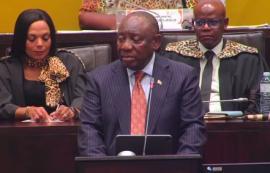
Traditional leaders are indispensable partners as government works to improve the economy and the lives of every South African man, woman and child.
“It is you who our people turn to in times of uncertainty and upheaval, and on whom they rely for guidance and wisdom that has been passed down through the ages and generations,” said President Cyril Ramaphosa, speaking at the opening of the National House of Traditional and Khoi-San Leaders on Thursday.
He said the institution of traditional leadership forms the sturdy roots that hold the great tree of the nation up.
“Traditional leadership is the institution that anchors us in history. It nourishes us with identity. It stabilises us when storms rage.
“In many of the provinces across our country, traditional leaders remain enablers of social cohesion, mediators of conflict, guardians of land and transmitters of culture. Long before the formal architecture of the modern state, there were systems of cogent accountability rooted in consensus and community.
“As the custodians of many of our cultures, customs and shared values that are the source of our nation’s strength, you hold the soil together, anchor the trunk and help us grow taller. Without strong roots, a nation cannot stand,” said the President.
He said the service delivery challenges in local government are felt particularly hard in rural areas.
“Where roads are poorly maintained, farmers cannot transport their goods to towns. Schoolchildren and the elderly have to travel long distances to get to clinics and schools, costing them money that is already in scarce supply.
“Rural areas are increasingly water-stressed. When the taps are dry, it doesn’t only affect households, but small-scale and communal farmers who rely on water to till the land, grow crops and sustain their livestock.
“The effects of climate change are worst in rural areas, as we saw with the recent floods in parts of Limpopo, Mpumalanga and KwaZulu-Natal. Extreme weather such as floods and droughts affect crop yields and the condition of livestock herds.
“As communities rooted in land and tradition, there is much we should learn from traditional communities as we approach these challenges,” said the President.
He said through the District Development Model, government has sought to align planning and service delivery across the country’s districts and metros.
“We continue to work with traditional leaders to gain an understanding of the conditions in their communities, of their specific needs and priorities, and to undertake development that is responsive to these realities.”
One area where impact is being felt in efforts to support youth development in rural communities is through public employment.
The Presidential Employment Stimulus has to date created over 2.5 million work and livelihood opportunities for young people, including in rural areas; the Social Employment Fund continues to support agricultural interventions for smallholder farmers, including skills development, training in sustainable farming practices and access to markets; the National Rural Youth Service Corps (NARYSEC) is having a positive impact on the lives of rural youth and last year, many young people in rural areas graduated from this programme, having received training in agriculture, construction, IT, hospitality and other areas.
“Agriculture is the lifeblood of rural communities. In the State of the Nation Address, I outlined the steps we are taking to support farmers and improve agricultural productivity across the country.
“We will continue to provide innovative funding to black producers, with the support of the Land Bank and commercial banks.
“This year we will be deploying 10 000 new agricultural extension officers across the country to provide technical support to both smallholder and commercial farmers.
“We will also be consolidating the training funded by the AgriSETA to bring more young people into the agriculture sector,” said President Ramaphosa.
With some of the world’s largest reserves of critical minerals lying beneath the soil, government has dedicated funding to mapping reserves and undertaking exploration.
Progressive legal and regulatory frameworks have sought to ensure that mining activity does not result in environmental degradation, displacement or loss of livelihoods.
“In some cases, rural communities have benefited from these developments, but in far too many instances they have not. As we work to harness the potential of our critical minerals, government and traditional leaders must work together to ensure that these resources create jobs and businesses in the areas where they are mined,” said the President.
He commended the House on the important work it has embarked on in partnership with government and other stakeholders. These include work with Habitat for Humanity, the Al-Imdaad Foundation, the National Heritage Council, the Hendrietta Bogopane-Zulu Foundation, and others.
“May this House continue to be a stabilising force in our democracy and national life. As our traditional leaders you must remain custodians of dignity and cohesion. And may you help lead the renewal of our rural economies, the empowerment of our youth, and the strengthening of our social fabric,” said the President. – SAnews.gov.za


