


In a significant multilateral initiative, a coalition of countries from various regions has agreed on six coordinated diplomatic, legal and economic measures aimed at restraining Israel’s actions in the occupied Palestinian territories and upholding international law.
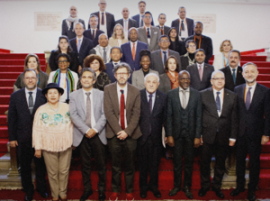
The Emergency Conference of The Hague Group, jointly organised by the governments of Colombia and South Africa as co-chairs, brought together 30 nations from Africa, Asia, Europe, North America, and South America.
“In the deliberations at the Bogotá conference, all 30 participating States unanimously agreed that the era of impunity must end – and that international law must be enforced without fear or favour through immediate domestic policies and legislation – along with a unified call for an immediate ceasefire,” a joint statement issued at the end of the conference read.
To initiate this process, 12 countries from around the world – Bolivia, Colombia, Cuba, Indonesia, Iraq, Libya, Malaysia, Namibia, Nicaragua, Oman, Saint Vincent and the Grenadines, and South Africa – convened in Bogotá, Colombia, for two days.
READ | Israel’s disregard for ICJ rulings undermines global governance, says Dangor
The countries committed to immediately implement six measures through their domestic legal and administrative systems.
The leaders have scheduled a meeting for 20 September, coinciding with the 80th United Nations General Assembly, to invite more countries to join this initiative. Consultations with governments worldwide are currently underway.
The countries have since announced several measures to be adopted based on the States’ domestic legal and legislative frameworks. This includes a ban on arms shipments to Israel, a prohibition on ships transporting such arms, and a review of public contracts to identify any links to companies benefiting from the Israeli occupation.
In addition, the group supports “universal jurisdiction mandates”, which would enable States or international bodies to prosecute serious international crimes, regardless of where they occurred.
“These 12 States have taken a momentous step forward,” said UN Special Rapporteur on human rights in the occupied Palestinian territory, Francesca Albanese.
“The clock is now ticking for States – from Europe to the Arab world and beyond – to join them.”
The conference agreed to set a deadline for States’ final decisions by September 2025, in line with the 12-month timeframe mandated by United Nations General Assembly Resolution A/RES/ES-10/24, adopted on 18 September 2024.
That resolution called on all States to take effective action on Israel’s violations of international law, including accountability, sanctions, and cessation of support -- within one year of adoption.
“We came to Bogotá to make history – and we did,” said Colombian President Gustavo Petro.
“Together, we have begun the work of ending the era of impunity. These measures show that we will no longer allow international law to be treated as optional, or Palestinian life as disposable.”
South Africa's International Relations and Cooperation Minister, Ronald Lamola, said what they have achieved is a collective affirmation that no State is above the law.
“The Hague Group was born to advance international law in an era of impunity. The measures adopted in Bogotá show that we are serious and that coordinated State action is possible,” said Lamola.
The Executive Secretary of The Hague Group, Varsha Gandikota-Nellutla, said the conference marks a turning point – not just for Palestine, but for the future of the international system.
“For decades, States, particularly in the Global South, have borne the cost of a broken international system. In Bogotá, they came together to reclaim it, not with words, but with actions.” – SAnews.gov.za


