


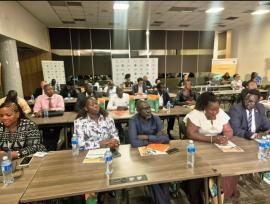
The Government Communication and Information System (GCIS) on Monday welcomed a high-level delegation from South Sudan, who are in South Africa on a media study visit aimed at learning from the country’s government communication and media operations.
The delegation, led by Mawien Bulabek Chon, Undersecretary in South Sudan’s Ministry of Information, Communication, Telecommunication and Postal Services, is undertaking a series of engagements with key government communication institutions.
Prior to their visit to the GCIS, the group met officials from the Department of Communications and Digital Technologies (DCDT) to gain insight into its mandate and operational structures.
Deputy Minister in the Presidency Kenny Morolong officially received the delegation and outlined the GCIS's constitutional mandate, which is to coordinate strategic government communication across all spheres of government.
“Our mandate is derived from the Constitution of the Republic of South Africa, which enjoins us to provide the citizens with timely, accurate and accessible information,” Morolong said.
Morolong briefed the delegation on South Africa’s communication evolution since the advent of democracy in 1994. He noted that the government inherited a South African Broadcasting Corporation (SABC) that needed to be transformed into an institution serving all South Africans and undertook major reforms to establish a communication system rooted in openness, accountability, and public service.
"In 1996, a Communication Task Report was established, comprising of intellectual individuals and seasoned media practitioners who engaged in a consultative process, which later heralded in the establishment of the Government Communication and Information System, which should be responsible for coordinating communicating government communication across all government departments.
“We are responsible for providing an oversight role over the Media Development and Diversity Agency (MDDA), which was also born out of the Jabulani Freedom of the Airwaves conference. MDDA was established in 2003 after an act of Parliament to support small community media.”
Morolong also reflected on South Africa’s recent hosting of the G20 Summit, saying the platform was used to advance Africa’s development agenda, including Agenda 2063 and broader Global South priorities.
“We have been able to use our G20 Presidency to elevate the Agenda of Africa, particularly the Agenda of 2063, the Africa we want, and also the agenda of the Global South. We have also been able to use the G20 Presidency to advocate for multilateralism,” Morolong said.
Media freedom
Acting Deputy Director-General for Content Processing and Dissemination at the GCIS, Sandile Nene, told the delegates that South Africa celebrates media freedom as a cornerstone of democracy, and that the organisation’s work is anchored in ensuring that the public has access to credible government information.
“All government departments have a duty to communicate to the public through GCIS. We work [closely] with the community media to communicate government information. GCIS has a system to monitor the community media to ensure efficiency [and ensure accurate dissemination of government information],” Nene said.
Chon said South Sudan saw a need to come and learn from South Africa because of shared historical experiences and democratic values.
"People of Sudan and South Africa are one, and we want to learn from you. With your support and experience, we will be able to strengthen our media sector in South Sudan,” Chon said.
MDDA Chief Executive Officer Shoeshoe Qhu briefed the delegation on South Africa’s community media landscape. She explained that the MDDA, established through a partnership between the South African Government and major print and broadcasting companies, provides financial and non-financial assistance to developing community and small commercial media in South Africa, amongst others.
Qhu said the first South African community radio station was licensed in 1995, marking a shift toward participatory broadcasting.
"[Today], community radio is a tool for social, economic, and political change, focusing on education, health, human rights, and empowering communities to participate actively in democratic processes,” she said.
According to the MDDA, the radio stations are governed by legislation, regulated by the Broadcasting Act, No. 4 of 1999 and overseen by ICASA to ensure diversity and fairness.
The GCIS was officially launched in May 1998. It was established in terms of Section 7 (subsection 2 and 3) of the Public Service Act, 1994 as amended.
The GCIS vision is empowering South Africans through communication excellence, with its mission being to deliver effective strategic government communication.
The department aims to meet citizens’ information needs through advertising government programmes, communicating government priorities and providing civic education. This will be achieved through using various media platforms, including community radio stations, social media, television, newspapers, and leaflets and flyers.
Meanwhile, South Sudan's media landscape is characterised by a mix of traditional and digital media outlets, each facing unique challenges. – SAnews.gov.za


