


South Africa’s economic diplomacy must become bolder and more strategic while also focusing on the African continent if it is to withstand escalating global uncertainty and advance its development goals.
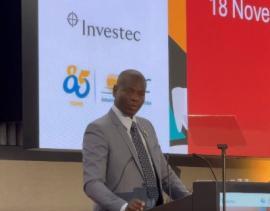
This was the central message delivered by Minister of International Relations and Cooperation (DIRCO) Ronald Lamola at a high-level Presidential Working Dinner with South African companies operating across the continent.
The working dinner, which forms part of the G20 Outreach Programme was held on Tuesday evening held at Investec, Sandton.
Speaking ahead of the G20 Leaders’ Summit, Lamola said South Africa is hosting the G20 “at a unique moment,” shaped by widening geopolitical fractures, volatile trade tensions and shifting global power centres.
“Responding to the uncertainties of today’s world, our government is fine-tuning an economic diplomacy strategy that rests on a few key assumptions and aspirations. In a world defined by competition for markets, minerals, technology, skills and investment, economic diplomacy can no longer be optional.
“It is an indispensable part of positioning South Africa for long-term resilience and addressing our domestic challenges.”
The Minister told business leaders that President Cyril Ramaphosa had instructed him to convene the dialogue following the European Union’s Gateway announcement, underscoring the strategic significance of ensuring that South African companies are supported as they expand into African markets.
READ | R230bn EU investment package will support growth
Strategy and potential
Lamola outlined the government’s emerging economic diplomacy strategy, built on a set of foundational assumptions and aspirations aimed at positioning South Africa more competitively.
At the heart of this strategy is the long-standing principle that “Africa is our home; Africa is our destiny,” a thread that has run through three decades of South African foreign policy.
“This economic diplomacy strategy gives practical expression to that orientation. The fate of our continent requires Africans, including ourselves, to act together to advance and defend our interests and to play our part in transforming the global order,” he said.
The strategy seeks to attract investment, stimulate growth and build stronger regional value chains, particularly in sectors such as critical minerals and manufacturing. These goals are aligned with the 2024–2029 Medium-Term Development Plan, which prioritises inclusive growth, reindustrialisation and the expansion of South Africa’s trade footprint.
He highlighted Africa’s immense economic potential: a young population, abundant mineral resources essential for the global energy transition, and a growing market that could reach USD 3.4 trillion under a fully implemented African Continental Free Trade Area (AfCFTA).
Yet, he also pointed to persistent obstacles. Only 16% of Africa’s trade is conducted within the continent, and the Southern African Development Community (SADC) region sits at 21%. He argued that South Africa must strive for 50% trade integration within the SADC to meaningfully boost continental trade.
Economic prospects
The Minister presented three “provocations” to guide conversations with business leaders, likening them to a three-legged pot holding Africa’s future economic prospects.
The first, he said, is the need to deepen regional investment in a reciprocal way. South African companies have long been catalytic players in African markets, building infrastructure, expanding telecommunications, and growing financial and retail networks.
However, these gains are often undermined by policy uncertainty, inconsistent regulations, stringent exchange controls, and occasional unfair treatment of South African firms. Such challenges weaken the growth of regional value chains, Lamola warned.
“Mr President, I am pleased to report that DIRCO and the dtic [Department of Trade, Industry and Competition], working closely with business, have established a new coordination platform to unlock opportunities across the continent.
“This mechanism, known as the Committee for the Coordination of Economic Diplomacy (COMED), brings Government and the private sector together to advance South Africa’s economic footprint,” he said.
A new investment facilitation framework is also under development, designed to support companies through foreign economic offices, improve regulatory guidance, strengthen risk-mitigation tools and enhance dispute-prevention mechanisms. This framework will be anchored in the Protection of Investment Act and complement both the AfCFTA Investment Protocol and the World Trade Organization (WTO’s) Investment Facilitation for Development.
The second leg of the “three-legged pot” addresses growing public scepticism at home toward regional integration.
Lamola said the government must demonstrate, tangibly, that regional cooperation and intra-African trade create meaningful economic benefits for ordinary South Africans not only for political leaders or commercial elites.
The third leg calls on business leaders themselves to embrace long-term thinking and resist the lure of short-term gains. Lamola argued that sustainable profits and broader societal returns are not mutually exclusive, and that a narrow horizon of immediate profit “serves none of us.”
“You may argue that this three-legged pot of provocations is missing one vital element. That is the fire to keep the pot burning. You are right, and it is us in this room that must start [the] fire.
“Through President Ramaphosa’s leadership, we can secure buy-in from key actors in society, especially the people in this room,” the Minister said.
Lamola credited President Ramaphosa’s leadership, strategic judgement and Ubuntu-centred approach as central to galvanising this collaboration. – SAnews.gov.za


