


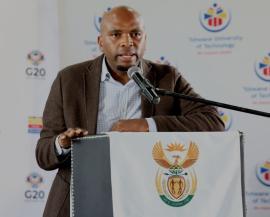
By Sandile Nene
The recent decision by the United States to grant refugee status to 49 Afrikaners who claimed persecution in South Africa is unfortunate. More so as the assessment allowing refugee status appears to have been greatly influenced by a deliberate campaign of misinformation and propaganda, which is far removed from the reality in South Africa.
The claim of systemic persecution against Afrikaners in South Africa, runs counter to the lived reality of millions of South Africans and contradicts the foundational values as enshrined in our Constitution.
South Africa remains a democratic rights-based society where no person or group is persecuted based on race, ethnicity or culture. We boldly challenge any assertion that people of a certain race or culture are being targeted for persecution.
As a nation which has deeply suffered true persecution under apartheid rule, we have worked tirelessly since the onset of our democracy to prevent it from ever occurring again by anchoring our Republic on the prescripts of our world-acclaimed Constitution.
Our Constitution remains the supreme law of the land, and we are a nation governed by the rule of law and our commitment to the ideals of freedom and democracy. Our rights, which many ordinary citizens fought and died for, are protected under our constitutional democracy. It promotes inclusivity, equality, non-racialism, non-sexism, national unity, social cohesion, justice and diversity.
The Constitution was designed to create an environment for all South Africans to work together in the interest of advancing our nation and the rights of all our citizens. It enshrines the rights of every South African and explains our obligations as citizens to each other and the country within those rights.
Moreover, our Constitution empowers government and society at large to take steps to promote equality by advancing people who have been disadvantaged by unfair discrimination emanating from our brutal past under apartheid. This has left us with a society with stark disparities in wealth, access to services, and economic opportunities.
Our transformation initiatives are necessary to build a more inclusive and equitable nation. It involves not only addressing our nation’s economic imbalances through transformation policies like broad-based black economic empowerment, affirmative action, preferential procurement and land reform, but also through fostering social cohesion, improving education, and ensuring fair representation across all sectors of society.
Our redress policies are not meant to punish any particular group but to heal a legacy of exclusion and ensure equal opportunity. These transformation policies are transparent, subject to legal oversight, and designed with the broader goal of national upliftment.
Those opposed to our nation’s transformation have perpetuated a campaign of disinformation and advanced a false narrative of discrimination. It is on the back of these allegations of discrimination, which do not meet the threshold of persecution required under domestic and international refugee law, that the refugee status was granted. The internationally recognised definition of refugees is someone with a “well-founded fear of persecution” based on race, religion, nationality, membership of a particular social group, or political opinion.
Moreover, a determination of refugee status requires a factual assessment of the prevailing circumstances in a country, which will demonstrate that there is no genocide or persecution of any grouping in our country. Importantly, statistics from the South African Police Services on farm-related crimes do not support allegations of violent crime targeted at farmers generally, or any race in particular. There is no arbitrary dispossession of land or private property in South Africa as alleged.
The decision by this small group of individuals to leave our country under the guise of victims of oppression is not a true reflection of the broader Afrikaner community, who have chosen to remain and participate meaningfully in South African society. The Afrikaner community remains a vital part of the national fabric and continues to thrive and contribute across various sectors of society.
In line with our Constitutional imperatives of freedom of movement and freedom of choice, government will not hinder any citizen who chooses to depart the country. We are an open and caring society, and those who feel fearful are encouraged to engage with government, civil society, and fellow citizens. There are sufficient structures available within South Africa to raise challenges and address concerns of discrimination.
Like many other nations around the world, we too grapple with complex social issues that lead to robust exchanges. We, however, choose to remain as citizens of our great nation, united in our efforts to create the country we envisaged at the start of our democracy, where no one is left behind.
*Sandile Nene is the Acting Deputy Director-General for Content Processing and Dissemination in the Government Communication and Information System (GCIS).


