


President Cyril Ramaphosa has called on South Africans to draw on the country’s deepest values and collective strength as it confronts challenges including crime and a worsening water crisis, declaring that the nation will stand firm both at home and on the global stage.
“To navigate this new world, we must draw on our strength as a nation. Our strength comes from our values. The values of dignity and equality, of non-racialism and non-sexism, diversity and of the inherent worth of every person. It comes from our people. From our tolerance, generosity, kindness and solidarity,” the President said.
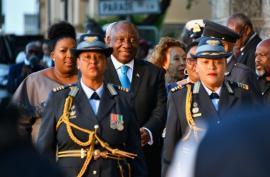
He was delivering the second State of the Nation Address (SONA) in the seventh administration at the City Hall in Cape Town on Thursday.
The evening commenced with a grand display of national pride which included a ceremonial guard, the singing of the national anthem, a 21-gun salute, an aircraft exhibition, and a full military band.
The President was ushered into the National Assembly by Ria Reen, a Khoi-San woman from the Northern Cape, with a powerful poetic voice.
Framing his address against the country's historic milestones of 1956, 1976 and the adoption of the Constitution in 1996, President Ramaphosa said South Africa’s resilience lies in its people, its institutions and its democratic ethos.
In an increasingly volatile global environment, the President made clear that South Africa’s sovereignty is non-negotiable.
“In a world where powerful nations often assert their dominance and influence over less powerful states, our country’s commitment to sovereignty and self-determination is sacrosanct. It is not negotiable.
“We will stand firm on our sovereignty and promote our national interests, values and the rights of our people. We are clear that we will continue to respect the rights and sovereignty of other nations, but we must be equally clear that we will not be bullied by any other country,” he said.
Confidence rising, economy stabilising
The President said South Africa is “stronger today than we were a year ago”, pointing to four consecutive quarters of GDP growth, two primary budget surpluses and declining borrowing costs.
“Our economy is growing again, and this growth is gathering pace. While we have experienced four consecutive quarters of GDP growth, we know that it has to grow much faster to meet our social and economic challenges.
“Our credit rating has improved, interest rates are coming down and inflation is at its lowest level in 20 years. We are on a clear path to stabilising our national debt. The Rand has strengthened against the Dollar,” the President said.
Government has committed more than R1 trillion in public investment over three years, the largest infrastructure allocation in the country’s history, targeting energy, logistics, water and digital infrastructure.
“All our actions now are driven by the need for rapid and inclusive economic growth to create more jobs and better quality jobs. To give effect to the Medium-Term Development Plan, Cabinet has approved a comprehensive implementation plan to drive growth and inclusion,” President Ramaphosa said.
Through Operation Vulindlela, structural reforms have been accelerated in energy, logistics and telecommunications. Load shedding has been brought to an end, and regulatory changes have unlocked a surge in renewable energy investment, with more than 40% of supply expected to come from renewable sources by 2030.
Significant reforms are also underway in rail and ports. Private rail operators now have access to the freight network, and public-private partnerships are being rolled out at port terminals and rail corridors.
Last month, government concluded a partnership with an international port operator to manage the Durban Pier 2 Container Terminal, aimed at restoring it to world-class standards.
“We have begun to turn around the performance of our rail system and ports, so that our businesses can get their products to global markets,” the President said.
Government remains focused on sectors that will drive future growth, including agriculture, mining, the green economy and digital services. New investments in rare earths, renewable energy manufacturing and data centres are positioning the country to compete in a rapidly changing global economy.
“We know that we can create millions of good quality jobs in sectors like agriculture, mining, services and the green economy. These are areas where we can be more than competitive. We can be the best in the world,” he said.
Despite the gains, President Ramaphosa was unequivocal that South Africa faces serious internal threats.
“Organised crime is now the most immediate threat to our democracy, our society and our economic development,” he said.
Government will consolidate intelligence at national level, identify priority syndicates and deploy multidisciplinary intervention teams to dismantle criminal networks. The South African National Defence Force will be deployed in parts of the Western Cape and Gauteng to support police in tackling gang violence and illegal mining.
“We cannot fight organised criminals by treading softly. We must act with zero tolerance and bring the full force of the law to bear. Let this message be clear: there will be no impunity for acts of corruption and criminality,” the President said.
A new criminal justice reform initiative, modelled on Operation Vulindlela, will be established in the Presidency to fast-track reforms across the system. The Whistle-Blower Protection Bill will be introduced, and procurement reforms will be accelerated to close corruption loopholes.
To tackle the water crisis in the country and coordinate a focused response, the President announced the establishment of a National Water Crisis Committee, which he will chair.
“This structure will bring together all existing efforts into a single coordinating body,” he said. It will ensure that action is taken swiftly and effectively to address the problem,” he said.
Jobs, youth and inclusive growth
Addressing high unemployment, especially among young people, the President said small businesses and public employment programmes would play a central role in job creation.
“If every small and medium business in South Africa could employ one additional person, we would create 3 million new jobs,” he said.
This year, government will provide more than R2.5 billion in funding to over 180 000 small and medium enterprises, extend R1 billion in guarantees and amend the National Credit Act regulations to improve access to affordable credit.
Public employment programmes, including the Presidential Employment Stimulus, EPWP and Community Works Programme, will be expanded and better coordinated to provide income support and pathways into longer-term work.
Government will also overhaul the skills development system, reform SETAs and strengthen TVET colleges as primary sites for artisan and occupational training.
“These reforms will ensure that various training programmes we have in government are a door to opportunity, not a dead end,” President Ramaphosa said.
A turning point
Concluding his address, the President described the moment as a national turning point.
“Our nation has reached a turning point. We are leaving behind an era of decline and turning towards an era of prosperity and growth.
“This must be the year that we make South Africa stronger. We must fix local government. We must fight crime and corruption and restore trust in the criminal justice system. We must create jobs and livelihoods for every South African.”
“Above all, we must ensure that this rising tide lifts every South African… This is the time for all south Africans to rise and we must rise together,” the President said. – SAnews.gov.za


