


Stronger public-private partnerships and blended finance are key to addressing South Africa’s infrastructure financing shortfall, says Human Settlements Minister Thembi Simelane.
Simelane made the call during the Dialogue on Municipal Infrastructure Sustainable Inclusive Communities, co-hosted by the University of South Africa’s Graduate School of Business Leadership and the Department of Human Settlements in Midrand on Tuesday.
Convened under the theme: “Building Blocks of Democracy: The Human Settlements Journey towards Inclusive Integrated Living”, the dialogue sought to outline pathways from housing delivery to inclusive integrated living; explore how municipal infrastructure integration sustains settlements, and chart the next chapter of resilient and spatially just communities.
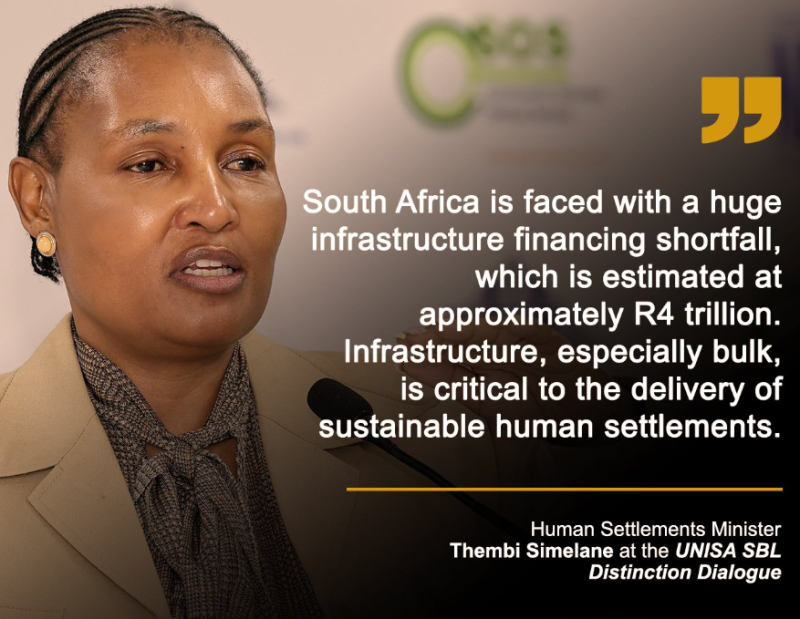
Simelane said South Africa is faced with a huge infrastructure financing shortfall, which is estimated at approximately R4 trillion.
She said strategic partnerships with commercial banks, including development finance institutions, pension funds, institutional investors and the private sector can help to mobilise additional investment and maximise the impact of limited public resources.
“The scale of South Africa’s housing demand and infrastructure requires us to move beyond traditional approaches to financing. The reality is that the State alone cannot afford the investment required. The solution lies in private sector partnerships and blended finance.”
The Minister said sustainable housing delivery depends on the coordinated planning and provision of land, housing and bulk infrastructure, including water and sanitation services.
She warned that a housing project without adequate infrastructure is at risk of failing, while homes built far from employment opportunities and public transport can increase spatial inequality and households’ cost of living.
“We must move away from fragmented planning and ensure that our human settlements are integrated and situated closer to economic opportunities, transportation facilities, and social amenities,” the Minister said.
Simelane reiterated her call for provincial housing plans, including municipal integrated development plans, spatial development frameworks and infrastructure budgets to be aligned before construction begins.
She said a project should have a credible implementation pathway covering land acquisition, planning approvals, infrastructure connections, occupation and appropriate tenure arrangements.
“The institutions responsible for operating and maintaining each asset must be identified from the outset.”
During its Budget Vote in May, the Department of Human Settlements set a target of 25 186 serviced sites during the 2026/27 financial year, a priority Simelane said illustrates the relationship between land readiness, infrastructure, and housing delivery in expanding housing opportunities.
Simelane said a site becomes useful to a household when the services needed are in place and can be sustained.
“Serviced land also creates room for different forms of housing delivery, including opportunities for qualifying households to build incrementally. Its value depends on sound planning, suitable location and functioning municipal systems,” Simelane said.
Strengthening municipalities
Simelane underscored the importance of municipal capacity to accelerate delivery, citing shortages of engineers, planners, financial managers and project managers, as well as unstable leadership and weak procurement processes, as factors that could undermine progress.
She called for targeted technical support to address specific municipal constraints and build lasting institutional capacity.
Accountability, she said, must extend beyond tracking expenditure to measuring whether infrastructure is functioning, households are connected and completed housing developments are occupied.
The Minister said maintenance must also be prioritised to prevent service interruptions and costly repairs.
“When maintenance is deferred, households pay through service interruptions, damaged property and additional expenses. Businesses lose operating time. The municipality then faces repairs that are more costly than the maintenance it postponed.”
The Minister also highlighted National Treasury’s Metro Trading Services Reform as an opportunity to strengthen the operational and financial performance of municipal water, sanitation, electricity and refuse removal services.
She said improvements in these services should support new housing developments and informal settlement upgrading, while ensuring the sustainability of existing communities. – SAnews.gov.za


