


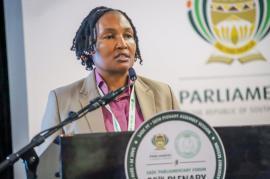
Human Settlements Minister Thembi Simelane has urged Southern African parliaments to take bold, people-centred action to confront what she described as an escalating climate crisis threatening development, human security, and the right to adequate housing across the region.
Simelane was addressing the Symposium of the 58th SADC Parliamentary Forum Plenary Assembly, held at Coastlands Hotel and Convention Centre in Umhlanga, north of Durban, on Monday.
Held under the theme: “The Impact of Climate Change in the SADC Region and the Role of Parliaments in Climate Mitigation and Adaptation”, the event brough together over 300 delegates representing Angola, Botswana, the Democratic Republic of Congo, eSwatini, Lesotho, Madagascar, Malawi, Mauritius, Mozambique, Namibia, Seychelles, South Africa, Zambia and Zimbabwe.
Simelane said the moment demands collective leadership and regionally aligned solutions.
“It is my greatest honour to address this Symposium of the 58th SADC Parliamentary Forum Plenary Assembly under a theme that could not be more urgent, more relevant, timely or more defining for our collective future.
“Climate change is no longer a distant environmental concern. It is a developmental crisis, a human settlements crisis, a socio-economic and governance crisis, and across the Southern African Development Community, it is increasingly becoming a human security crisis,” Simelane said.
Simelane noted that the SADC region is now facing climate impacts of “unprecedented scale,” with storms becoming more violent in recent years, droughts more severe, floods more frequent and destructive, and heatwaves more deadly.
She noted the recent flooding in KwaZulu-Natal, including displacement of people in Umshwathi Local Municipality, whose homes were swept away in the past few days, as a result of the devastating effects of climate change.
“As we have seen, devasting climate events do not follow national borders. What we have experienced here in Durban and along the Eastern Seaboard of South Africa, has also affected multiple countries simultaneously. In the same way that we are all affected, no single country therefore can address this challenge alone,” Simelane said.
Most vulnerable communities hit hardest
Drawing on South Africa’s Climate Change Risk and Vulnerability Assessment, Simelane said the groups most affected by climate disasters are rural communities already facing poverty and limited access to services; residents of informal and peri-urban settlements located in floodplains, steep slopes, wetlands, and fire-prone areas; and women, youth, and children who bear the brunt of inadequate livelihoods, exposure, and socio-economic stress.
“Climate change is not gender neutral. Women are disproportionately exposed, disproportionately impacted, and disproportionately responsible for absorbing the shocks. And yet, women, despite being at the frontlines of climate impacts, remain at the margins of climate decision-making. That must change,” the Minister said.
Young people, she added, are growing up in “a world shaped by climate uncertainty”, and inherit the consequences of decisions they did not make.
“They are the most powerful drivers of innovation, resilience, and adaptation; their creativity, energy, and digital fluency make them essential partners in building climate-resilient communities.”
Strategic pillars for regional climate resilience
Simelane outlined South Africa’s Climate Change Response Strategy and Implementation Plan for Human Settlements, which guides resilience-building efforts to 2030, and proposed three pillars relevant for the wider SADC region:
Pillar 1: Settle people in safe places and preserve the ecosystems that protect them
The Minister stressed the need to avoid placing communities on flood-prone land, wetlands, unstable slopes, coastal danger zones, and heat-stressed areas. “This is the first and most fundamental line of defence against climate hazards.”
Pillar 2: Addressing vulnerable settlements already in unsafe locations
The Minister noted that millions of people already live in hazardous locations. She called for upgrade informal settlements in-situ where possible; improve essential services such as water, sanitation, and electricity; and greater investment in nature-based solutions—wetlands, urban greening, vegetated buffers.
Pillar 3: Establish climate-resilient infrastructure norms, standards and settlement typologies
Simelane emphasised that South Africa infrastructure must withstand new climate realities.
“These shifts will reduce future losses, enhance liveability, and create safer communities. Critically, we must invest in Innovative Building Technologies (IBTs) as the human settlements’ infrastructure of the future, which is reliable, resilient, and durable to mitigate climate change,” she said.
Leading a just transition
Simelane also emphasised that climate resilience is not solely a technical process, but “a community-driven process.”
“We must build a region where communities do not only receive climate information but shape it; where they do not only participate in planning but lead it; and do not only face climate risks but help define the solutions. Disasters move across borders, so information must too.
“As Parliaments we shape the laws, budgets, oversight mechanisms and standards that determine whether our region is prepared or unprepared for the future,” she said, calling for climate-risk integration into land-use legislation, alignment of human settlements laws with regional climate frameworks, and effective mobilisation of climate finance for vulnerable communities.
As the region approaches the midpoint of what she described as “a decisive decade,” Simelane challenged lawmakers to choose proactive resilience over reactive recovery.
“The question before us is simple: Will we build a region that waits for disasters to strike, or a region that acts before disaster becomes inevitable?” she asked.
She urged the delegates to embrace the moment not as a threat, but an opportunity to “reshape our communities, to strengthen our democracies, and to build a region that thrives in the face of climate change.” – SAnews.gov.za


