


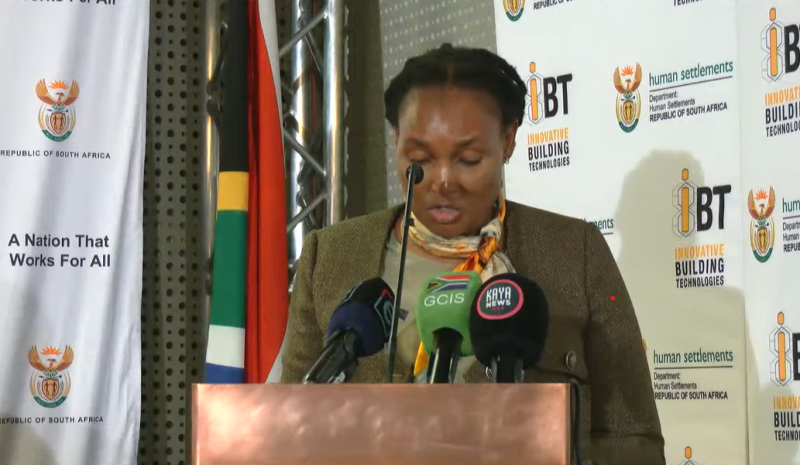
Human Settlements Minister Thembi Simelane says South Africa must move beyond the delivery of individual houses towards integrated and sustainable human settlements that connect communities to essential services, economic opportunities and secure tenure.
Simelane was speaking during The Platform on Thursday, where she outlined the role of human settlements in addressing some of the challenges facing local government.
The Platform on Thursday is a weekly high-level webinar series hosted by the Department of Human Settlements, where government leaders and sector experts discuss key issues regarding local government, housing delivery and urbanisation.
In her address under the topic: “Getting the Basics Right for Local Government: Harnessing the Role of an Activist Middle Class” - Simelane said reliable water and sanitation, electricity, roads, refuse removal, well-managed land, lawful building approvals and maintained infrastructure, are not modest ambitions, but the foundations of dignity.
“They are also the foundation of investment, jobs, public health, and democratic trust. For most people, government is first experienced locally. A national policy only becomes meaningful when land is released, services are connected, plans are approved, projects completed and title deeds registered, and households live safely,” the Minister said.
Simelane said South Africa's settlement patterns continue to reflect the geography of apartheid, with many low-income households located far from employment, education, and public transport.
She argued that well-located, mixed-income and mixed-use developments should be viewed not only as housing interventions, but also instruments of spatial redress, economic policy, and long-term municipal financial sustainability.
Simelane also highlighted the Constitutional Court's Tafelberg ruling, saying the judgment affirmed that the right to adequate housing includes the location of housing and requires government to actively provide affordable housing in well-located areas rather than pushing lower-income residents to the peripheries of economic centres.
“[A human settlement] is a home connected to water, sanitation, electricity, roads, and transport; located within reach of schools, clinics, work, and economic opportunity; supported by safe public spaces; and underpinned by secure tenure,” Simelane said.
Simelane warned that failures in any part of this delivery chain can result in projects being developed far from jobs, houses without bulk infrastructure, informal settlements without basic services and social housing projects being delayed by disconnected land, finance, approvals and infrastructure processes.
She said the delivery chain requires all three spheres of government to work together, with national government responsible for policy, programmes and major grants, provinces for planning and managing housing programmes, and municipalities for land-use planning, bulk infrastructure, local services and approvals.
“The household does not experience three spheres of government; it experiences one State. Our work is to make that State function as one system,” she said.
For the 2026/27 financial year, the department's Annual Performance Plan targets 36 884 completed housing units, 19 393 serviced sites and 26 917 registered title deeds.
On informal settlements, the department is targeting 21 settlements to complete Phase 1 upgrading, 53 to complete Phase 2 and 79 to complete Phase 3.
Simelane said the phased upgrading programme is not about treating informal settlements as temporary problems to be removed, but providing basic services, safer living conditions, appropriate tenure arrangements and pathways towards formalisation and improved livelihoods.
She stressed the importance of title deeds, saying secure tenure enables families to protect, transfer and use their homes as a foundation for intergenerational wealth.
At the same time, Simelane said well-located social and affordable housing remained critical in a rapidly urbanising society, where ownership is not the only legitimate housing need.
The Minister reiterated that spatial transformation must now move from planning into implementation.
Of 136 declared Priority Human Settlements and Housing Development Areas, development plans have been completed for 112. The next step, she said, is to align these plans with municipal infrastructure, transport, social amenities, land assembly, budgets and investable project pipelines.
The Minister also called for disaster response to become more risk-informed, including through better spatial data, stronger preparedness, avoiding the rebuilding of vulnerability, and scaling appropriate Innovative Building Technologies where these can improve speed, quality, durability, resilience, local manufacturing and skills. – SAnews.gov.za


